Less nerdy than usual.
First beer in the southern hemisphere: http://hoplogblog.blogspot.com.ar/2012/10/first-beers-in-southern-hemisphere.html
Mendoza, AR: http://hoplogblog.blogspot.com.ar/2012/10/mendoza.html
Bariloche, AR: http://hoplogblog.blogspot.com.ar/2012/10/bariloche.html
Enjoy!
Showing posts with label Santiago. Show all posts
Showing posts with label Santiago. Show all posts
Thursday, October 25, 2012

Saturday, October 20, 2012
Santiago to Mendoza via the Andes
Back in Santiago for a day before catching a bus to Argentina. We went to the Mercato Central - mostly touristy restaurants, but with a pretty serious fish market attached.
We hear Santiago is one of the most air-polluted cities in South America, and the views don't lie. We could finally see the Andes through the smog this day.
Grabbed a snack at the Vega (locals') market.
Mote Con Huesillos is a very sweet/thick drink, somewhat like iced tea, but made with big chunks of canned peaches (I had 1/2 a peach in mine) and whole barley at the bottom - hence the spoon. Hot dogs are common in Chile, and a "Completos" has tomatoes, saurkraut and a line of mayonnaise. Not the healthiest lunch, but filling for < $2.50 total.
Next day we caught a bus through the Andes to Mendoza, Argentina, about 7 hours total. Comfy bus, and absolutely stunning scenery. The Canadian Rockies are beautiful, but let's not kid ourselves, they're nowhere near as BIG as the Andes are. The road we travelled goes over a 3500m (11,500 foot) pass. (All photos were taken out the window of the bus.) More info on the road here: Paso Internacional Los Libertadores


After gaining a LOT of elevation, we encountered a pretty steep pass. The road went right up it - about 30 switchbacks in a row.
After the initial set of switchbacks, I thought we'd be at the top. Oh no. Plenty of switchbacks and high alpine still left. [Sarah: Each turn is numbered, curvo 1 through about 30].


After descending for what seemed like forever, we hit a broad plain of glacial debris with an opaque, terra-cotta-coloured river running through it. It turns out we were maybe half way down at best.


As we were coming out onto the plains east of the Andes, we could see Mount Aconcagua behind us - the highest mountain in the world outside of the Himalayas at 6962m (22,800 feet). That's 3 kilometres taller than Mt. Robson, the highest mountain in the Canadian Rockies. (Mendoza is on the desert plains, at only 750m (2500 feet) elevation.)
Rolling into the flat, dry deserts around Mendoza was a bit underwhelming, but the promise of wine was fresh in our minds. (Irrigation has allowed the area to become a renowned wine growing region, so we were ready for some Malbec!)

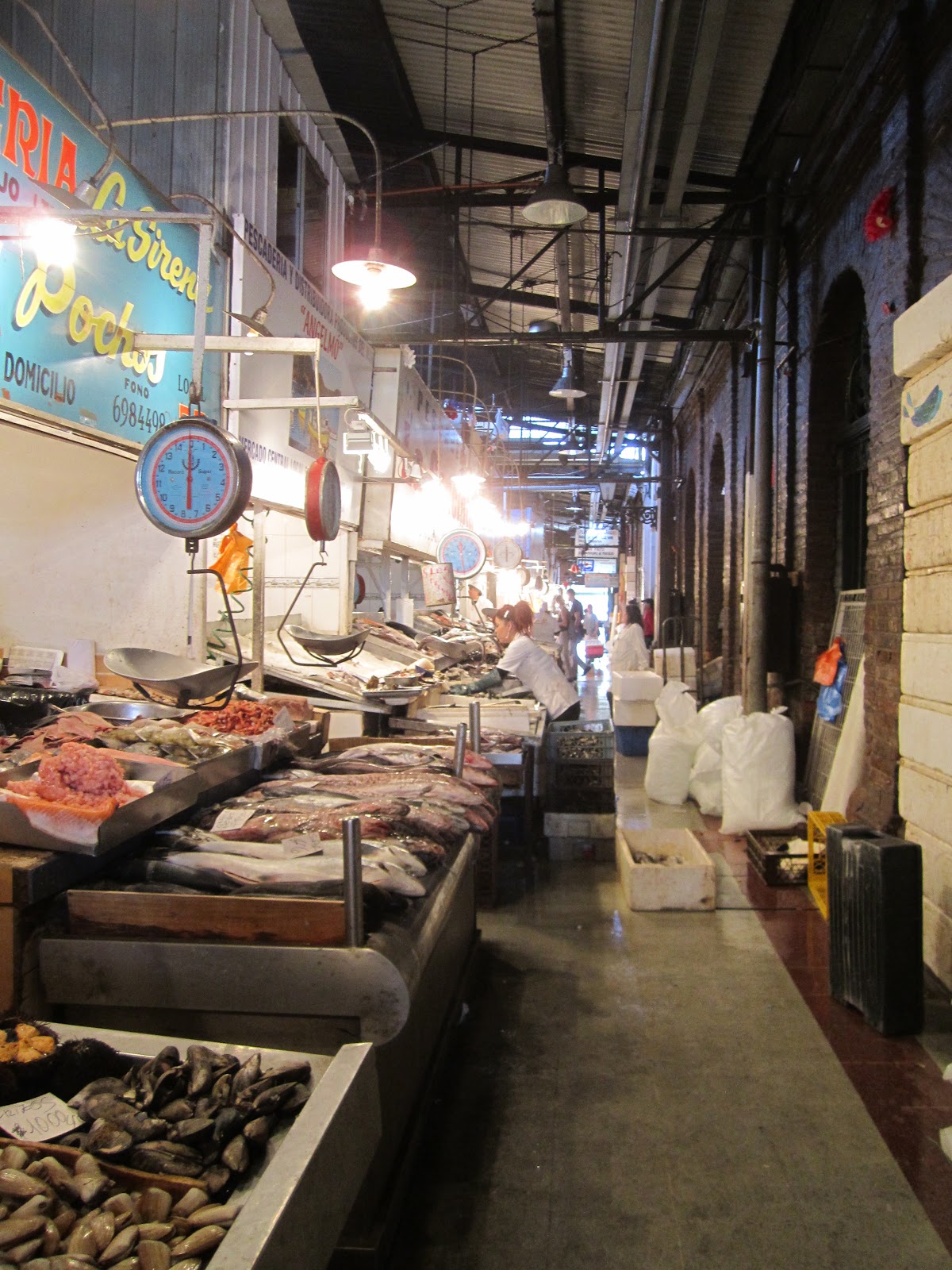 |
| Fish market |
 |
| Central restaurant area. |
We hear Santiago is one of the most air-polluted cities in South America, and the views don't lie. We could finally see the Andes through the smog this day.
 |
| Some Andes overlooking Santiago |
Grabbed a snack at the Vega (locals') market.
 |
| Mote Con Huesillos and a Completos hot dog |
Mote Con Huesillos is a very sweet/thick drink, somewhat like iced tea, but made with big chunks of canned peaches (I had 1/2 a peach in mine) and whole barley at the bottom - hence the spoon. Hot dogs are common in Chile, and a "Completos" has tomatoes, saurkraut and a line of mayonnaise. Not the healthiest lunch, but filling for < $2.50 total.
Next day we caught a bus through the Andes to Mendoza, Argentina, about 7 hours total. Comfy bus, and absolutely stunning scenery. The Canadian Rockies are beautiful, but let's not kid ourselves, they're nowhere near as BIG as the Andes are. The road we travelled goes over a 3500m (11,500 foot) pass. (All photos were taken out the window of the bus.) More info on the road here: Paso Internacional Los Libertadores
 |
| First glimpse of proper snowy peaks |

 |
| Up a narrow ravine |
 |
| Oh yeah, now THAT'S a mountain |


After gaining a LOT of elevation, we encountered a pretty steep pass. The road went right up it - about 30 switchbacks in a row.
 |
| Switchbacks from below - can't really see them |
 |
| We just went up that - note lack of barriers |
After the initial set of switchbacks, I thought we'd be at the top. Oh no. Plenty of switchbacks and high alpine still left. [Sarah: Each turn is numbered, curvo 1 through about 30].
 |
| Avalanche sheds |
 |
| Getting close to the top. There was a ski hill at this height, but I can't imagine plowing the road to it in the winter! [Sarah: the guidebook warns that the road will close for days at a time in the winter if they get too much snow at once. Now I can see why!] |
 |
| Once we hit the height of the road & went through the Argentine border, the mountains became really colourful and varied. The camera didn't pick up the vibrancy of colours very well. |

 |
| Those aren't cloud shadows, they're purple rocks |
 |
| Faced with this much scenery, a man just has to have his Sprim |


After descending for what seemed like forever, we hit a broad plain of glacial debris with an opaque, terra-cotta-coloured river running through it. It turns out we were maybe half way down at best.


As we were coming out onto the plains east of the Andes, we could see Mount Aconcagua behind us - the highest mountain in the world outside of the Himalayas at 6962m (22,800 feet). That's 3 kilometres taller than Mt. Robson, the highest mountain in the Canadian Rockies. (Mendoza is on the desert plains, at only 750m (2500 feet) elevation.)
 |
| Mt. Aconcagua |

Monday, October 15, 2012
Santiago Part Dos
Santiago is big, and there is much to explore, so we set out on our second day to do just that. Our first stop was to the west of our hostel, in a different direction than the way we had been the day before. The architecture continued to vary greatly from block to block.
Our first stop of the day was to get some culture at the (free) Museo de la Memoria y los Derechos Humanos (or, for us gringos, the Museum of Memory and Human Rights). The museum is dedicated to human rights abuses during the years of the Pinochet dictatorship, during which 3,000 people were killed or "disappeared", and over 100,000 were tortured or detained. I didn't know much about this until we got here, other than a general idea that Pinochet = evil. Of course, as always, it is a lot more complicated than that. In particular, in Chile Pinochet doesn't = evil for everyone.
The Museum was stark from the outside, similar in some ways to the holocaust memorial in Berlin, and very interesting inside - despite the fact that only about 1/3 of the exhibits were in English so we had to piece together what the rest was all about. Of particular note were the recordings of Salvador Allende in his final address to the nation - as the military coup was happening and the parliament was being shelled - and of Pinochet's introduction to his new government/dictatorship.
[Note from Chad: what I learned is that Salvadore Allende won the presidency as a Marxist in the early 1970s, at the head of a left wing coalition. Many working-class people in Chile were quite downtrodden, and he began trying to improve their lot, including through nationalizing many large resource corporations and making other changes. However, the government overspent itself and the economy got into trouble with inflation, etc. The country was split roughly between the working classes that welcomed changes, and more conservative upper/middle classes who didn't want to lose their wealth. Pinochet, leader of the army, headed a well-organized coup with the cooperation of all branches of the military and national police force - tanks rolled into the streets and shelled the parliament, as did air force aircraft. The president said he would not abandon his post, and shot himself before the army took over the building, rather than being tortured/killed or being forced into exile. Allende's off-the-cuff last speech (subtitled along with a recording), over the telephone to one of the few radio stations not controlled by the army, while the parliament was under seige, is an amazing piece of oration and I can't believe how someone under that kind of pressure could be so eloquent. This was September 11, 1973. The speeches by Pinochet and the other coup leaders (navy, police, etc.) said that they felt bound to save the country from the terrible direction they were being taken by the communist president - and remember this was the height of the cold war. In fact, it appears the CIA had an $8 million budget dedicated to destabilizing this duly elected government, such was their paranoia of the left at the time. Many right-leaning citizens celebrated the coup by dancing in the streets and drinking champagne (being the class who could afford champagne) while their fellow citizens were being killed in the takeover. The following year saw the regime's forces sweep through the entire country, capturing and killing any perceived opposition to the regime, mostly left wing political figures, trade unionists, etc. Pinochet began a long period of austerity and economic reforms that lifted controls and allowed freer market access, which after about a decade bore fruit and resulted in a more robust economy. But atrocities (including secret imprisonment, murder and torture, all outlined in the museum) continued regularly through a secret police force, and the country was tightly controlled by Pinochet until he stepped down in the late 1980s - but not before passing a law ensuring he was immune from any prosecution. (Though it's hard to believe any "law" passed by decree, by a dictator without any official mandate from the people governed, could be considered legitimate in modern times.) Apparently Chileans either love Pinochet or hate him; personally, I can't see how the means could possibly justify any ends.]
Afterwards, we took a stroll through a huge park across the street. It was Saturday and there were many people out and about.
A point of note is that Chile is full of dogs. Some of them are pets, some of them are strays, the vast majority of them are really, really cute. Sadly, none of them can be pet - our travel medical nurse tells us that we should act as if all of them have rabies, and it is readily apparent that most of them have fleas. Their ubiquitous presence also means you always need to watch where you step, as the sidewalks are full of their waste.
Back at the hostel we tried another kind of Chilean beer as we did some travel planning. Escuda is not as good as Cristal, but still better than our low benchmark (Turkish Efes).

More wandering in the evening, this time past the Moneda Palace where the 1973 coup took place, which is the official seat of Chilean government. Beautifully lit up at night.

As advertised in every guidebook I read, Santiago isn't the most exciting city in the world. But it's a great introduction to Chile and a nice place to spend a few days.
 |
| Nice, Euro-style building. Almost castle like. |
 |
| And... a less Euro-style building. There are just as many of these, if not more. |
The Museum was stark from the outside, similar in some ways to the holocaust memorial in Berlin, and very interesting inside - despite the fact that only about 1/3 of the exhibits were in English so we had to piece together what the rest was all about. Of particular note were the recordings of Salvador Allende in his final address to the nation - as the military coup was happening and the parliament was being shelled - and of Pinochet's introduction to his new government/dictatorship.
 |
| The museum is in the green part of the building that appears under construction (it's not). The UN's universal declaration of human rights is imprinted on the right hand wall. |
 |
| A Chilean guy contemplates the square filled with pictures from the Pinochet era (or, more likely, checks his email on his cell phone), including identification of victims from their remains, decades later. |
[Note from Chad: what I learned is that Salvadore Allende won the presidency as a Marxist in the early 1970s, at the head of a left wing coalition. Many working-class people in Chile were quite downtrodden, and he began trying to improve their lot, including through nationalizing many large resource corporations and making other changes. However, the government overspent itself and the economy got into trouble with inflation, etc. The country was split roughly between the working classes that welcomed changes, and more conservative upper/middle classes who didn't want to lose their wealth. Pinochet, leader of the army, headed a well-organized coup with the cooperation of all branches of the military and national police force - tanks rolled into the streets and shelled the parliament, as did air force aircraft. The president said he would not abandon his post, and shot himself before the army took over the building, rather than being tortured/killed or being forced into exile. Allende's off-the-cuff last speech (subtitled along with a recording), over the telephone to one of the few radio stations not controlled by the army, while the parliament was under seige, is an amazing piece of oration and I can't believe how someone under that kind of pressure could be so eloquent. This was September 11, 1973. The speeches by Pinochet and the other coup leaders (navy, police, etc.) said that they felt bound to save the country from the terrible direction they were being taken by the communist president - and remember this was the height of the cold war. In fact, it appears the CIA had an $8 million budget dedicated to destabilizing this duly elected government, such was their paranoia of the left at the time. Many right-leaning citizens celebrated the coup by dancing in the streets and drinking champagne (being the class who could afford champagne) while their fellow citizens were being killed in the takeover. The following year saw the regime's forces sweep through the entire country, capturing and killing any perceived opposition to the regime, mostly left wing political figures, trade unionists, etc. Pinochet began a long period of austerity and economic reforms that lifted controls and allowed freer market access, which after about a decade bore fruit and resulted in a more robust economy. But atrocities (including secret imprisonment, murder and torture, all outlined in the museum) continued regularly through a secret police force, and the country was tightly controlled by Pinochet until he stepped down in the late 1980s - but not before passing a law ensuring he was immune from any prosecution. (Though it's hard to believe any "law" passed by decree, by a dictator without any official mandate from the people governed, could be considered legitimate in modern times.) Apparently Chileans either love Pinochet or hate him; personally, I can't see how the means could possibly justify any ends.]
Afterwards, we took a stroll through a huge park across the street. It was Saturday and there were many people out and about.
 |
| Most of these paddle boats looked like they could sink at any moment. |
 |
| Chad is teaching me about science using these ancient looking satellite-dish thingy's outside the science museum. [Note from Chad: parabolic sound reflectors! Classic.] |
A point of note is that Chile is full of dogs. Some of them are pets, some of them are strays, the vast majority of them are really, really cute. Sadly, none of them can be pet - our travel medical nurse tells us that we should act as if all of them have rabies, and it is readily apparent that most of them have fleas. Their ubiquitous presence also means you always need to watch where you step, as the sidewalks are full of their waste.
 |
| This guy was wandering around like he owned the place. So cute! So potentially rabid! |
 |
| Another fine example of colourful Santiago - just a little corner store. |

More wandering in the evening, this time past the Moneda Palace where the 1973 coup took place, which is the official seat of Chilean government. Beautifully lit up at night.

 |
| The oldest remaining building in Santiago, the church of San Francisco, from the 1700s. |
As advertised in every guidebook I read, Santiago isn't the most exciting city in the world. But it's a great introduction to Chile and a nice place to spend a few days.
Big Walk Around Town
Our first complete day in Chile we walked around Santiago for about 6 hours under misty skies that burned off just after noon.
What we noticed: Chileans are pretty calm, and friendly in a sincere way when you need assistance. There's not a lot of cafe culture, but there are of course restaurants and bars (just not acres of patio space). Our guidebook tells us Chile is the most organized and least corrupt country in South America, which seems to be true. And weirdly, Scotiabank seems to be one of the top 3 banks in the country.
It was a short walk to the Plaza de Armes, the main square in the old town where old dudes play chess in the gazebo and well-dressed religious nuts proselytize at maximum volume. Lots of calm national police (caribineros) presence doesn't interfere with daily life. The main pedestrian shopping corridor runs past the Plaza.
A bit north on the pedestrian street one comes to the Mapocho river - not the most attractive aqueduct, but with a decent bit of green space (and highway) running beside it. The tourist market is on the south side, and the more local-oriented Vega market is on the north side, with a decent selection of food, clothing and mini restaurants.
We headed to the Bella Vista neighbourhood, which is home to a couple of universities and a dense restaurant/bar scene, though nothing was open (before noon) when we arrived. We decided to walk up Cerro San Cristobal - a prominent hill overlooking Bella Vista, with a Mary statue, cable car, parks, etc. on top. And when I say decided, I mean that the funicular was closed for maintenance that day.
We walked past a little zoo on the way down, where Sarah wisely adopted the proper "play dead" position in the face of an escaping grizzly bear.

Then cheap empanadas for lunch, oh my!
We walked further east, into the newer part of town with office towers and international hotel and restaurant chains, which felt a lot more generic.

We took the cheap & efficient metro back to our hostel, and had a snack and a beer. Then we went to a craft beer bar for dinner. Yes, craft beer is popping up occasionally even in Chile! We sampled all of their draught beers (mostly from one Santiago brewer - Rothhammer), and while I wasn't a big fan of most of them, their IPA was very nice. (Even the very young barley wine was decent.) A mug of IPA each and a huge thin crust pizza each made for a good night. [Sarah: My favourite parts were when the very friendly waiter 'warned' us that we had walked into a craft beer place, and when he called the IPA "eepa". We weren't sure whether to correct him or not - maybe that is what it's called down here!]
What we noticed: Chileans are pretty calm, and friendly in a sincere way when you need assistance. There's not a lot of cafe culture, but there are of course restaurants and bars (just not acres of patio space). Our guidebook tells us Chile is the most organized and least corrupt country in South America, which seems to be true. And weirdly, Scotiabank seems to be one of the top 3 banks in the country.
 |
| One corner of the Plaza de Armes |
A bit north on the pedestrian street one comes to the Mapocho river - not the most attractive aqueduct, but with a decent bit of green space (and highway) running beside it. The tourist market is on the south side, and the more local-oriented Vega market is on the north side, with a decent selection of food, clothing and mini restaurants.
 |
| The Mapocho and Vega market, plus the beginning of a big river mural depicting environmental destruction... |
 |
| ...and the rest of the mural, that ends with grass and butterflies on the end |
 |
| The forest park runs along the river |
We headed to the Bella Vista neighbourhood, which is home to a couple of universities and a dense restaurant/bar scene, though nothing was open (before noon) when we arrived. We decided to walk up Cerro San Cristobal - a prominent hill overlooking Bella Vista, with a Mary statue, cable car, parks, etc. on top. And when I say decided, I mean that the funicular was closed for maintenance that day.
 |
| Purple poppies on the trail |
 |
| A hazy/smoggy view part way up |
 |
| Looking down from the Mary statue - theoretically the Andes are in the background somewhere |
 |
| I get the feeling we're going to see a lot of statues like this in S. America |
We walked past a little zoo on the way down, where Sarah wisely adopted the proper "play dead" position in the face of an escaping grizzly bear.

Then cheap empanadas for lunch, oh my!
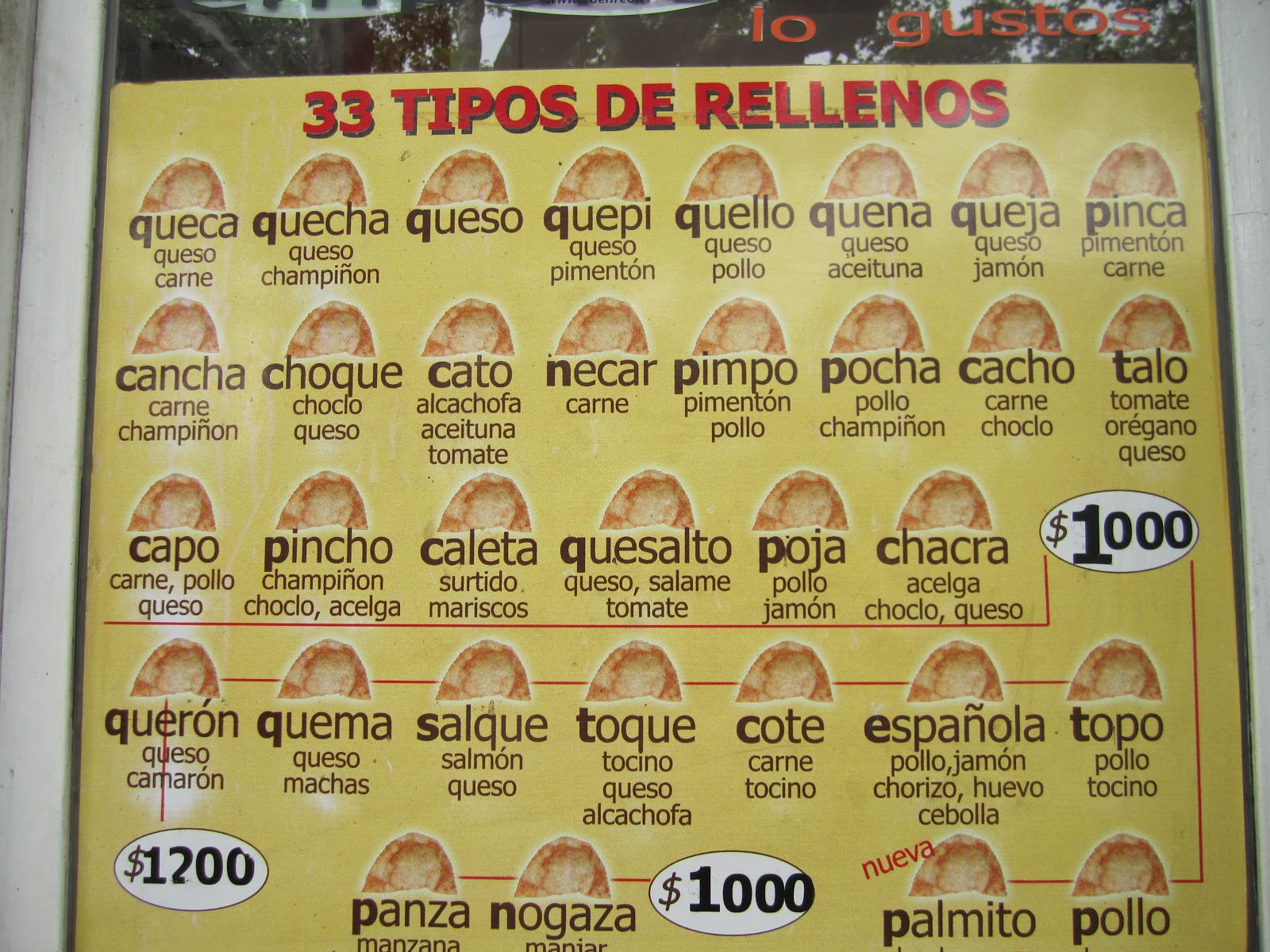 |
| The empanadas are not made of gold - $1000 is in Chilean pesos: a bit less than $2.50 CDN |
 |
| Sarah loves her Italian-seasoned empanada |
We walked further east, into the newer part of town with office towers and international hotel and restaurant chains, which felt a lot more generic.
 |

 |
| This is at the "W" hotel; it's hard to see but the whole interior wall (several stories) is filled with wine |
We took the cheap & efficient metro back to our hostel, and had a snack and a beer. Then we went to a craft beer bar for dinner. Yes, craft beer is popping up occasionally even in Chile! We sampled all of their draught beers (mostly from one Santiago brewer - Rothhammer), and while I wasn't a big fan of most of them, their IPA was very nice. (Even the very young barley wine was decent.) A mug of IPA each and a huge thin crust pizza each made for a good night. [Sarah: My favourite parts were when the very friendly waiter 'warned' us that we had walked into a craft beer place, and when he called the IPA "eepa". We weren't sure whether to correct him or not - maybe that is what it's called down here!]
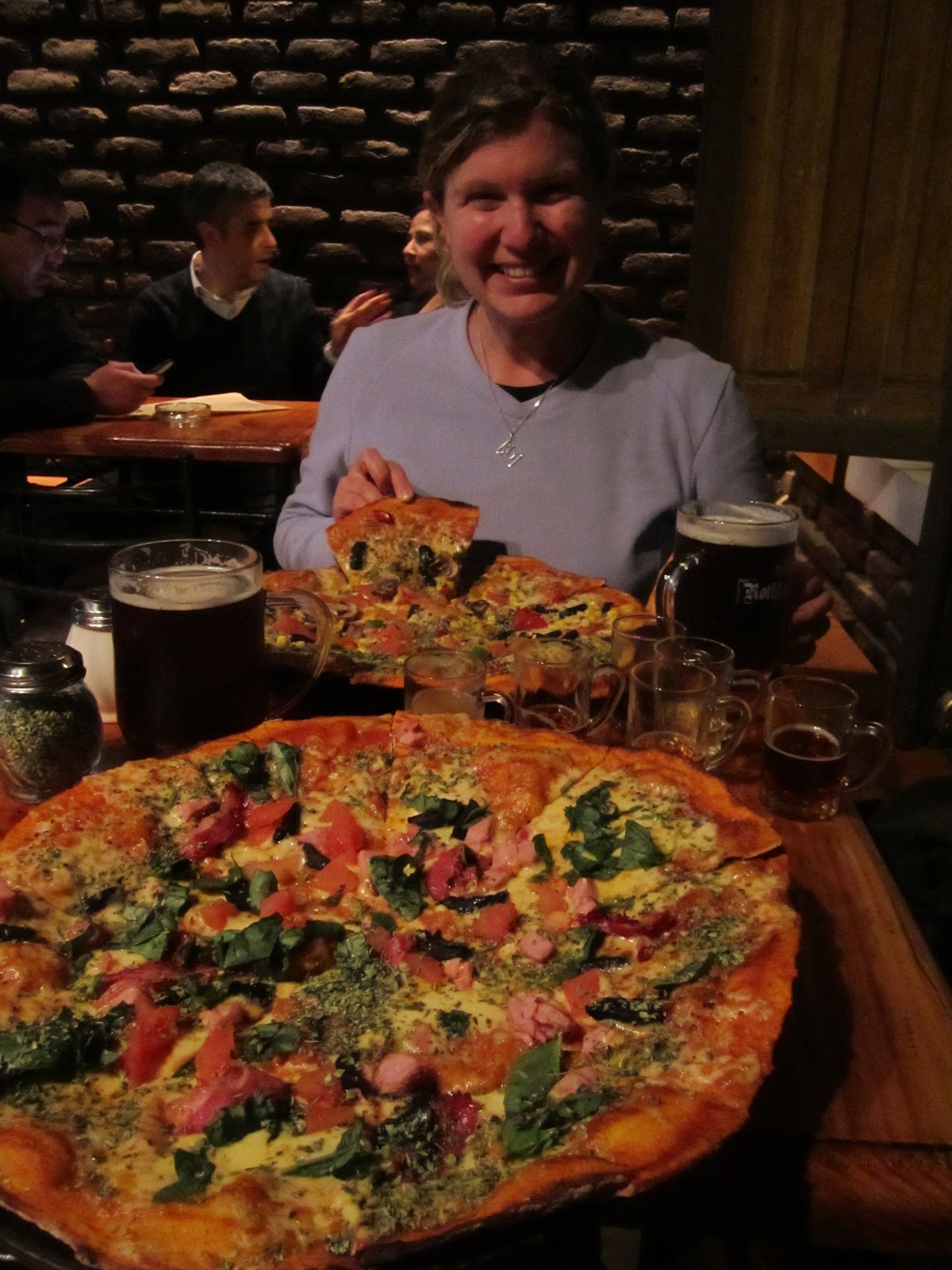 |
| [Sarah: These pizzas are not as big as they appear in this picture, I swear! They were super tasty, and made a good dinner and lunch for the next day.] |
Subscribe to:
Posts (Atom)