Over on the Hoplog Blog:
Cambodia Cold Ones
(A bit overdue - as you know, dear reader, we left Cambodia several weeks ago.)
Enjoy!
Showing posts with label Cambodia. Show all posts
Showing posts with label Cambodia. Show all posts
Thursday, April 4, 2013

Friday, March 15, 2013
Angkor, What?
We thought Phnom Penh was pretty awesome, but our next adventure awaited us to the north - Siem Reap and the famous temples of Angkor Wat. Of course, we had to get there first. Fly? Not a chance (it was hundreds of dollars each). Figuring we've proved our traveller's mettle at using local transport already this year, we avoided the local busses and took a fancy Giant Ibis bus that made the 300 km trip to Siem Reap in just under six and a half hours.
The bus was a great way to see some Cambodian countryside - lots of rice fields, houses on stilts, and garbage remnants (exclusively tons and tons of plastic bags and bottles strewn all along the roadside). [Note from Chad: given the poorness of the country, it's not surprising that perfect litter pickup is not achieved.] Arriving in Siem Reap we set ourselves up at our lovely hotel and headed to check out the town. It is full to the brim with tourists, and apparently has been built up a lot over the last five years in particular as the gateway to Angkor Wat. Lots of good restaurants to choose from and places to spend your shopping dollars. [Note from Chad: But inexpensive and lacking the usual "tourist trap resort" feel, thankfully.]
We found a Mexican place recommended by Grace and Luke with food to rival any Mexican I've ever had before (and I've tried out a lot). [Note from Chad: I think Sarah was just happy to have food that was safe for her to eat.]
After dark, downtown turns into one giant night market with lots of lovely lights.


And the next day it was time for the serious business of temple visiting. We went all out and hired a guide for Angkor Wat as well as a tuk-tuk to drive us around for the day. Totally worth every penny. The heat was insufferable for biking, and our guide was awesome (all official guides are university-trained and government-sanctioned) - he knew his stuff, told me all the best places to take photos, and arranged our tour so we saved the shady part for the hottest part of the day.
The Temples of Angkor are Cambodia's pride and joy (Angkor Wat is on their national flag), and for good reason. Angkor Wat itself is the largest temple - and the world's largest religious building - but there are 90 other temples scattered around this area and 400 in the province. The Siem Reap temple area was a city that, at its height around 1000-1200 AD, had a population of one million people (possibly the largest in the world).
[Note from Chad: according to our guide, at the height of the empire the Angkor kings would build three temples during their lifetime. The reach of the empire was vast, and building the temples was a great honour, so no slave labour was used. The amount of engineering and artistic skill that went into these temples meant a huge number of professional-level people had to be employed - especially since the window of time to build each temple was fixed and finite before work began, and they had to be completed within the king's lifetime. For example, legend has it that Angkor Wat (including all buildings, wall and moat) was completed in as little as 9 years, though some say it might have been more like 32 years. Anything less than 100 years is unbelieveable - consider that European cathedrals took several centuries to complete. Each new king felt that to hold the people in awe (and keep control), he needed to build a bigger temple than the last king - hence the huge number of big temples in the area. Most of the temples contain Hindu art, though many contain Buddhist themes (or a combination), depending on the religion of the king at the time. And most of the more popular temples have seen significant restoration efforts, so they're in much more "original" condition now than, say, 100 years ago. This is fine, except for those temples that look exotic due to their ruinous nature (like the "Lara Croft - Tomb Raider" temple) and which are in the middle of being made unfortunately "nice".]
Angkor Wat is surrounded by a moat that is a giant rectangle - 1.5 km by 1.3 km, and 190 metres wide. Keep in mind, this was all dug by hand and/or elephant.

Our first glimpse of the eastern (minor) gate - a bit crumbling but even the gates are impressive with clean, straight lines and ornate carvings.

And through the gate is the granddaddy of all temples - Angkor Wat. Not to rave, but it is breathtaking. It was built from 1113-52 by King Suryavagman II, who was different from earlier kings because of his devotion to the Hindu deity Vishnu. Angkor Wat has been in virtually continuous use since it was built.


Angkor Wat housed about 2000 monks and 2000 dancers back in the day. Dancers were very important, chosen very young and trained continuously to represent godly perfection. Monks could have families, but dancers could not, and the two groups kept separate.

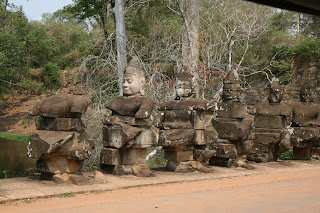
Our next stop was the also-lovely Angkor Thom; less renown but far larger than Ankgor Wat. Angkor Thom is famous for its bas-relief of the Churning of the Ocean of Milk, in which 54 gods and 54 demons are engaged in a tug of war, on its entrance gate structure. This relief has been carefully restored and is very impressive. And it is not the only one!
Inside of Angkor Thom is the Bayon, which is a temple built by King Jayavarman VII. It has 54 gothic towers decorated with 216 enormous stone faces. The Lonely Planet says the faces "smile coldly" and "glare down" on you, but our guide thought they were happy faces. Photos don't do it justice - it's amazing.


Next was the Victory Gate - Pisa's favourite, and pretty damn cool.

Our team outside our much-needed lunch stop.


Our last stop of the day was Ta Prohm, which was built in 1186 and has been mostly taken over by the jungle since then. Scenes from the movie Tomb Raider were filmed here.


Colour me cynical, but I did not expect to be impressed by Angkor Wat (or Cambodia for that matter). But the temples of Angkor truly blew me away - they really are one of the wonders of the world. And we found Cambodia - at least the already-touristed parts that we visited - to be accessible and full of friendly people eager to help us out. Overall, a highlight of our trip!
 |
| Hello, fancy bus with snacks, intermittent wifi, and good A/C. |
 |
| Seeking out the shade at a rest stop along the way. |
The bus was a great way to see some Cambodian countryside - lots of rice fields, houses on stilts, and garbage remnants (exclusively tons and tons of plastic bags and bottles strewn all along the roadside). [Note from Chad: given the poorness of the country, it's not surprising that perfect litter pickup is not achieved.] Arriving in Siem Reap we set ourselves up at our lovely hotel and headed to check out the town. It is full to the brim with tourists, and apparently has been built up a lot over the last five years in particular as the gateway to Angkor Wat. Lots of good restaurants to choose from and places to spend your shopping dollars. [Note from Chad: But inexpensive and lacking the usual "tourist trap resort" feel, thankfully.]
 |
| Phnom Penh and Siem Reap have lots of 'Happy Pizza' places where they apparently serve marijuana on your pizza. (Not sure how that matches up with their strict anti-narcotic drug laws.) I can only guess what they put on your pizza at this place. |
We found a Mexican place recommended by Grace and Luke with food to rival any Mexican I've ever had before (and I've tried out a lot). [Note from Chad: I think Sarah was just happy to have food that was safe for her to eat.]
 |
| Yes, this is a delicious mango margarita. |
 |
| I am just as thrilled with my fresh watermelon juice. |
After dark, downtown turns into one giant night market with lots of lovely lights.


And the next day it was time for the serious business of temple visiting. We went all out and hired a guide for Angkor Wat as well as a tuk-tuk to drive us around for the day. Totally worth every penny. The heat was insufferable for biking, and our guide was awesome (all official guides are university-trained and government-sanctioned) - he knew his stuff, told me all the best places to take photos, and arranged our tour so we saved the shady part for the hottest part of the day.
The Temples of Angkor are Cambodia's pride and joy (Angkor Wat is on their national flag), and for good reason. Angkor Wat itself is the largest temple - and the world's largest religious building - but there are 90 other temples scattered around this area and 400 in the province. The Siem Reap temple area was a city that, at its height around 1000-1200 AD, had a population of one million people (possibly the largest in the world).
[Note from Chad: according to our guide, at the height of the empire the Angkor kings would build three temples during their lifetime. The reach of the empire was vast, and building the temples was a great honour, so no slave labour was used. The amount of engineering and artistic skill that went into these temples meant a huge number of professional-level people had to be employed - especially since the window of time to build each temple was fixed and finite before work began, and they had to be completed within the king's lifetime. For example, legend has it that Angkor Wat (including all buildings, wall and moat) was completed in as little as 9 years, though some say it might have been more like 32 years. Anything less than 100 years is unbelieveable - consider that European cathedrals took several centuries to complete. Each new king felt that to hold the people in awe (and keep control), he needed to build a bigger temple than the last king - hence the huge number of big temples in the area. Most of the temples contain Hindu art, though many contain Buddhist themes (or a combination), depending on the religion of the king at the time. And most of the more popular temples have seen significant restoration efforts, so they're in much more "original" condition now than, say, 100 years ago. This is fine, except for those temples that look exotic due to their ruinous nature (like the "Lara Croft - Tomb Raider" temple) and which are in the middle of being made unfortunately "nice".]
Angkor Wat is surrounded by a moat that is a giant rectangle - 1.5 km by 1.3 km, and 190 metres wide. Keep in mind, this was all dug by hand and/or elephant.

Our first glimpse of the eastern (minor) gate - a bit crumbling but even the gates are impressive with clean, straight lines and ornate carvings.

And through the gate is the granddaddy of all temples - Angkor Wat. Not to rave, but it is breathtaking. It was built from 1113-52 by King Suryavagman II, who was different from earlier kings because of his devotion to the Hindu deity Vishnu. Angkor Wat has been in virtually continuous use since it was built.

 |
| See the big colonnades? Their inside walls are covered with bas-relief carvings. |

 |
| Even monks gawk at Angkor Wat! (And they take iPhone photos) |


 |
| Reflected in the ladies' bathing pool as we walked away. Not that I'd be doing any bathing in that pool! |
Angkor Wat housed about 2000 monks and 2000 dancers back in the day. Dancers were very important, chosen very young and trained continuously to represent godly perfection. Monks could have families, but dancers could not, and the two groups kept separate.

 |
| My first elephant sighting ever! |

Our next stop was the also-lovely Angkor Thom; less renown but far larger than Ankgor Wat. Angkor Thom is famous for its bas-relief of the Churning of the Ocean of Milk, in which 54 gods and 54 demons are engaged in a tug of war, on its entrance gate structure. This relief has been carefully restored and is very impressive. And it is not the only one!
 |
| The Churning of the Ocean of Milk. |
 |
| This relief stretches as far as the eye can see. |
Inside of Angkor Thom is the Bayon, which is a temple built by King Jayavarman VII. It has 54 gothic towers decorated with 216 enormous stone faces. The Lonely Planet says the faces "smile coldly" and "glare down" on you, but our guide thought they were happy faces. Photos don't do it justice - it's amazing.


 |
| The Bayon has 1.2 km of bas-reliefs which portray scenes of daily life and incorporate more than 11,000 figures! |
 |
| See the faces? |

 |
| Our awesome guide, Mr. Pissa. |

 |
| Chad climbed up to get some better views - I stayed at the bottom, not keen on a staircase sloped at up to 80 degrees! |


Next was the Victory Gate - Pisa's favourite, and pretty damn cool.

 |
| Note the elephant carvings |
Our team outside our much-needed lunch stop.

This is a gigantic swimming pool that apparently isn't very good for swimming. But it was genuinely dug 1000 years ago, primarily for bathing. I'm sure millions could bath in it at once.

Our last stop of the day was Ta Prohm, which was built in 1186 and has been mostly taken over by the jungle since then. Scenes from the movie Tomb Raider were filmed here.

 |
| Cool un-restored rubble on the left, reconstructed temple on the right |


 |
| This before and after shot was useful for demonstrating how much reconstruction really has been done in some parts. |

Colour me cynical, but I did not expect to be impressed by Angkor Wat (or Cambodia for that matter). But the temples of Angkor truly blew me away - they really are one of the wonders of the world. And we found Cambodia - at least the already-touristed parts that we visited - to be accessible and full of friendly people eager to help us out. Overall, a highlight of our trip!
Monday, March 11, 2013
The Killing Fields
Another sobering day for the McFrothys - we were off to discover a bit more about the Khmer Rouge, Pol Pot and the killing fields, something I didn't know much about at all.
Southeast Asia has been no stranger to war and misery, but word of such things does not seem to make its way to the western world very well (except for the Vietnam war). For example, in WWII, because of demands for food by the Japanese occupying forces in Vietnam together with a drought, something like 2 million Vietnamese died from famine. But because of the focus on casualties in Europe and the Pacific naval battles, I never knew this.
The history of the area is complicated, and I'm sure a quick visit to Wikipedia would be much better than me stumbling through it (probably incorrectly) here. At any rate, after WWII, communist organizations began to rise in the area - the Viet Cong in North Vietnam, another organization in Laos, and the Khmer Rouge in Cambodia (led by Pol Pot's iron fist, though he never appeared in public). During the Vietnam war, Cambodia was bombed by the US in an attempt to cut off North Vietnam's supply lines that ran through the country. Also, during an absence of the Cambodian king there was a military coup, and the new leadership demanded that North Vietnamese communist forces leave the country. The Khmer Rouge gained domestic support by rallying against the military rulers in the name of the king, and was aided by the North Vietnamese who needed to keep Cambodian supply lines open. Eventually, the Khmer Rouge & their allies were successful in the civil war and their forces marched victoriously into Phnom Penh in April 1975.
If the people thought they were saved, they were in for a truly horrific shock. The day the Khmer Rouge entered Phnom Penh, every single person, regardless of age, sex or health, was ordered to march out into specific areas of the countryside to begin farming and manual labour - some had to make it half way across the country on foot. All schools were closed. The postal system was closed. Embassies were closed and foreigners expelled. Currency was abolished. Markets, newspapers, religious practices were forbidden. Any resistance or delay was instantly met with death.
The Khmer Rouge wanted to create a completely pure agrarian society, a peasant's "worker's paradise". So everyone had to go work in the fields and the ditches, without exception. Cities were emptied, and only the military remained in them. Production targets were set to unreasonably high levels, especially for city folk with no farming experience. The local party leaders, fearing what might happen if they missed their production targets, worked everyone 12+ hours per day, every day, with no breaks and no days off, and with minimal food to eat. Women were not even allowed to stop to breast feed their babies during the work day. Any resistance or delay meant you were against the revolution, which generally resulted in death. The borders with neighbouring countries were closed, so little word of conditions leaked out and few people escaped.
Pol Pot and the regime were particularly suspicious and paranoid, so the tiniest smell of something being wrong meant you were killed. Not just killed, but tortured until you made a false confession, then killed, and then likely your whole family killed as well - "to remove grass you must also pull up its roots" was the saying. Their policy was exactly the opposite of the western world's: better to kill 100 innocents than let 1 traitor slip through your grasp.
But you didn't have to underperform or disagree to be killed. You could just be suspected of something. Or someone could just mention your name to the right person in the right tone, and that was it. Furthermore, you could be offed simply because of your profession or your station in life. Anyone with any valuable skill or profession was considered elite and not proper material for agricultural work or to be a true revolutionary - so doctors, lawyers, professors and academics, police and military, public servants, other races, clergy, the middle class, and especially teachers (ironic given that many of the top Khmer Rouge leadership were teachers and were university-educated) - anyone with any significant amount of education or non-labour skill, was eliminated.
The killing fields were the official but secret locations where executions took place (those that weren't carried out summarily in public, that is). There were over 300 such locations in Cambodia - the most well known is about 15 km outside of Phnom Penh, and is now a memorial site. This is the site we visited, officially known as Choeung Ek. Formerly a Chinese cemetery, it was converted to a killing field and surrounded by a fence to keep out prying eyes.

A twisted tree beside the site where prisoners were unloaded from trucks at night, hands behinds their backs and blindfolded. They were kept in a dark shed. Narrow, deep mass graves were pre-dug by the guards (up to 16 feet deep). In the middle of the night a diesel generator was turned on for light, and revolutionary songs were blasted over loudspeakers to cover the sound of any screams. Then the prisoners were taken one-by-one to the grave, killed (or gravely wounded), and thrown in.

Cambodia was pretty poor during these times, and even items like bullets were considered expensive - particularly if you had to use many of them to kill your own citizens. So these killing field deaths were not instant and easy for the executioner, like they would be with a gun or a gas chamber - virtually all of them involved clubbing and stabbing the victims to death, a serious physical effort. Cart axels, shovels, axes, hoes, palm knives, bamboo clubs - it was horribly medieval. For example, take a look at the sugar palm tree above. It grows near to where the guard/executioner shack was.

Close inspection reveals that the branches are very strong, and have extremely hard, nearly razor sharp serrated edges, like a wood saw. This is one of the things they would use to slit the throats of the prisoners (to eliminate screams) after clubbing them in the back of the neck. Absolutely shocking.

Most of the mass graves have been excavated, and the human remains catalogued. The first one we walked by was the biggest in the site - 450 bodies were found in it. There are a total of 88 such mass graves in this killing field, containing at least 9000 bodies - though several of the less-accessible graves were not disturbed, so there are likely many more bodies than this (estimates vary, but somewhere around 14,000-20,000 total). And this is just one out of more than 300 killing field sites.

Each depression is a mass grave site. While most have been excavated, bits of bone, teeth and clothing slowly work their way to the surface with the rains and are collected every month or so. It's unbelievable how callously so many were murdered, and by hand. One mass grave contained nothing by headless bodies wearing Khmer Rouge military khakis - those who were suspected of disloyalty. Another grave contained nothing but the remains of women (mostly naked) and children - it was situated by a large tree. Bits of skull, brain and hair were found on the tree - it turns out that the most efficient way to kill small children by hand is to hold them by the legs and bash their heads against a tree. Which is what they did. The horrors go on and on. Thank goodness there was a school nearby with the sounds of children playing happily outside, to take a bit of the edge off the experience.
A large memorial stupa overlooks the killing fields now. Inside are about 10 platforms you can see through glass windows. Each platform contains the bones of people from these fields. Traditionally, stupas hold Buddhist relics (such as an eyelash of the Buddha or something), so this stupa similarly contains relics of the victims.

The first 7 levels are nothing but skulls, categorized by age, sex, etc. Thousands of them. It's a brilliant and sobering memorial - no one can forget or deny what happened when faced with this kind of tribute.

Not exactly feeling chipper after the memorial tour (and the very good audio guide it comes with), we hopped into our waiting tuk-tuk and headed to S21, the Tuol Sleng Genocide museum.
The killing fields were where the executions happened. But S21 was where many of the victims came first. Formerly a school in the middle of Phnom Penh, it was converted into a semi-secret torture prison by the Khmer Rouge. People suspected or accused of anti-revolutionary behaviour (the accusation could be almost anything, and was usually fabricated) were brought here, held and tortured until they gave a false and forced confession. (Non-admission did not mean you were innocent, it just meant you were lying and needed to be tortured more.) When the full confession was obtained, and any "information" gleaned from the torture had been recorded, victims would be loaded onto trucks bound for the killing fields just outside of town. Like the Nazis, the Khmer Rouge kept detailed records about all prisoners - translations of some of their files, including the forced confessions, are provided for visitors to view.

Hallway outside the classrooms, most of which were filled with cells made of brick or wood, though some were torture rooms. Not only were many of the original torture devices on display, but they had paintings showing the operation of the devices - clearly painted with those actual devices as subjects. Effective and chilling.

I guess I'd expect such an overwhelmingly strict set of rules at a torture chamber, but wow.

The school yard. The frame has pulleys at the top so people could be suspended as a method of torture. But there were much worse methods employed here.

It's tough to see, but on this building the original barbed wire covers the balconies outside of the cell rooms, so that if a prisoner got loose he couldn't commit suicide by jumping to his death. Some estimates indicate that up to 20,000 people came through this prison - but there are only 7 known/confirmed survivors. About 20 sites like this one were operated by the Khmer Rouge in Cambodia.
The Khmer Rouge were officially in power for 3.75 years. While there is some controversy on the numbers, it's clear that somewhere between 1 and 3 million people died - out of a population of approximately 8 million. Most did not die from execution and torture, but from the horrible living and working conditions imposed upon them and from famine created by Khmer Rouge policies. I can't imagine what effect this experience had on generations of Cambodians. And I'm stunned that I didn't know more about these atrocities and the number of deaths, other than some vague references to Pol Pot and killing fields in my younger days. This was an unbelievably terrible, largely preventable extermination of human life that happened during my lifetime - yet it seems to have gotten relatively little attention in the west. I imagine it's the usual shameful recipe: this was on the other side of the world, in a secretive area, without significant/valuable natural resources, was no imminent threat to the west, and involved people of non-western descent.
Even more unbelievable is the persistence of the Khmer Rouge. It seems they were eventually forced from power because they kept launching border skirmishes with battle-hardened Vietnam, who lost patience and invaded, ousting the Khmer Rouge leadership in a matter of several days. The Khmer Rouge leaders fled into exile (largely to Thailand, if I recall correctly), but the regime held significant influence in the country, particularly in rural areas where government influence was weak, for many years. (Our tour guide at Angkor Wat related that people from his village didn't want him to go off to university studies, even though he was awarded a scholarship. They were uneducated, and very frightened and mistrustful of education because the Khmer Rouge had killed all the educated people. Notably, after the Khmer Rouge were officially defeated, some people came to town and said that the country needed all the people who used to be teachers and doctors, etc, to help out with the country now that the rulers had changed. So many people went on a truck with these people - who turned out to be Khmer Rouge and who killed them all for being teachers and doctors, etc.as usual. So his fellow villagers understandably equate seeking education with execution.)
Vietnam helped to set up a new government in Cambodia. However, because Vietnam was essentially part of the Soviet Bloc and these were cold war days, the west didn't want to recognize any government set up by a Soviet-backed country - so many of the most powerful western nations continued to recognize the Khmer Rouge as the "legitimate" government-in-exile of Cambodia, giving its leaders a seat at the UN (and even aid)! How Pol Pot survived to die of old age (poison was rumoured, but he lasted until his 70s, which is a much longer life than most of his victims) rather than in a prison is totally beyond me. Other Khmer Rouge leaders are being prosecuted for crimes against humanity, etc, but it is an extremely long, drawn-out process, and it seems entirely possible that others will pass away naturally before their trials are finished.
With that, we needed a break to refresh our overloaded brains. So we did some travel planning and booking, visited a craft brewery (more on that in the Hoplog blog later), and went to see a movie at The Flicks 1 that night.

The Flicks are a few small theatres run largely by expats, whose proceeds go to local good causes. The Flicks 1 takes up about half of a large house, and has a waiting area lounge where you can get drinks and snacks before hitting the air conditioned 32-seat theatre and its collection of love seats and floor mattresses. The movies are simply a projector attached to a laptop, but there's full digital surround sound and the quality is great. Highly recommended if you want an air conditioned break in Phnom Penh.

(We watched Zero Dark Thirty, the movie about finding and killing Osama Bin Laden. After our day spent at the killing fields and the torture prison, it sure was alarming to watch torture (waterboarding, etc.) taking place on the big screen.)
Southeast Asia has been no stranger to war and misery, but word of such things does not seem to make its way to the western world very well (except for the Vietnam war). For example, in WWII, because of demands for food by the Japanese occupying forces in Vietnam together with a drought, something like 2 million Vietnamese died from famine. But because of the focus on casualties in Europe and the Pacific naval battles, I never knew this.
The history of the area is complicated, and I'm sure a quick visit to Wikipedia would be much better than me stumbling through it (probably incorrectly) here. At any rate, after WWII, communist organizations began to rise in the area - the Viet Cong in North Vietnam, another organization in Laos, and the Khmer Rouge in Cambodia (led by Pol Pot's iron fist, though he never appeared in public). During the Vietnam war, Cambodia was bombed by the US in an attempt to cut off North Vietnam's supply lines that ran through the country. Also, during an absence of the Cambodian king there was a military coup, and the new leadership demanded that North Vietnamese communist forces leave the country. The Khmer Rouge gained domestic support by rallying against the military rulers in the name of the king, and was aided by the North Vietnamese who needed to keep Cambodian supply lines open. Eventually, the Khmer Rouge & their allies were successful in the civil war and their forces marched victoriously into Phnom Penh in April 1975.
If the people thought they were saved, they were in for a truly horrific shock. The day the Khmer Rouge entered Phnom Penh, every single person, regardless of age, sex or health, was ordered to march out into specific areas of the countryside to begin farming and manual labour - some had to make it half way across the country on foot. All schools were closed. The postal system was closed. Embassies were closed and foreigners expelled. Currency was abolished. Markets, newspapers, religious practices were forbidden. Any resistance or delay was instantly met with death.
The Khmer Rouge wanted to create a completely pure agrarian society, a peasant's "worker's paradise". So everyone had to go work in the fields and the ditches, without exception. Cities were emptied, and only the military remained in them. Production targets were set to unreasonably high levels, especially for city folk with no farming experience. The local party leaders, fearing what might happen if they missed their production targets, worked everyone 12+ hours per day, every day, with no breaks and no days off, and with minimal food to eat. Women were not even allowed to stop to breast feed their babies during the work day. Any resistance or delay meant you were against the revolution, which generally resulted in death. The borders with neighbouring countries were closed, so little word of conditions leaked out and few people escaped.
Pol Pot and the regime were particularly suspicious and paranoid, so the tiniest smell of something being wrong meant you were killed. Not just killed, but tortured until you made a false confession, then killed, and then likely your whole family killed as well - "to remove grass you must also pull up its roots" was the saying. Their policy was exactly the opposite of the western world's: better to kill 100 innocents than let 1 traitor slip through your grasp.
But you didn't have to underperform or disagree to be killed. You could just be suspected of something. Or someone could just mention your name to the right person in the right tone, and that was it. Furthermore, you could be offed simply because of your profession or your station in life. Anyone with any valuable skill or profession was considered elite and not proper material for agricultural work or to be a true revolutionary - so doctors, lawyers, professors and academics, police and military, public servants, other races, clergy, the middle class, and especially teachers (ironic given that many of the top Khmer Rouge leadership were teachers and were university-educated) - anyone with any significant amount of education or non-labour skill, was eliminated.
The killing fields were the official but secret locations where executions took place (those that weren't carried out summarily in public, that is). There were over 300 such locations in Cambodia - the most well known is about 15 km outside of Phnom Penh, and is now a memorial site. This is the site we visited, officially known as Choeung Ek. Formerly a Chinese cemetery, it was converted to a killing field and surrounded by a fence to keep out prying eyes.

A twisted tree beside the site where prisoners were unloaded from trucks at night, hands behinds their backs and blindfolded. They were kept in a dark shed. Narrow, deep mass graves were pre-dug by the guards (up to 16 feet deep). In the middle of the night a diesel generator was turned on for light, and revolutionary songs were blasted over loudspeakers to cover the sound of any screams. Then the prisoners were taken one-by-one to the grave, killed (or gravely wounded), and thrown in.

Cambodia was pretty poor during these times, and even items like bullets were considered expensive - particularly if you had to use many of them to kill your own citizens. So these killing field deaths were not instant and easy for the executioner, like they would be with a gun or a gas chamber - virtually all of them involved clubbing and stabbing the victims to death, a serious physical effort. Cart axels, shovels, axes, hoes, palm knives, bamboo clubs - it was horribly medieval. For example, take a look at the sugar palm tree above. It grows near to where the guard/executioner shack was.

Close inspection reveals that the branches are very strong, and have extremely hard, nearly razor sharp serrated edges, like a wood saw. This is one of the things they would use to slit the throats of the prisoners (to eliminate screams) after clubbing them in the back of the neck. Absolutely shocking.

Most of the mass graves have been excavated, and the human remains catalogued. The first one we walked by was the biggest in the site - 450 bodies were found in it. There are a total of 88 such mass graves in this killing field, containing at least 9000 bodies - though several of the less-accessible graves were not disturbed, so there are likely many more bodies than this (estimates vary, but somewhere around 14,000-20,000 total). And this is just one out of more than 300 killing field sites.

Each depression is a mass grave site. While most have been excavated, bits of bone, teeth and clothing slowly work their way to the surface with the rains and are collected every month or so. It's unbelievable how callously so many were murdered, and by hand. One mass grave contained nothing by headless bodies wearing Khmer Rouge military khakis - those who were suspected of disloyalty. Another grave contained nothing but the remains of women (mostly naked) and children - it was situated by a large tree. Bits of skull, brain and hair were found on the tree - it turns out that the most efficient way to kill small children by hand is to hold them by the legs and bash their heads against a tree. Which is what they did. The horrors go on and on. Thank goodness there was a school nearby with the sounds of children playing happily outside, to take a bit of the edge off the experience.
 |
| (Tower is not leaning, the photographer is) |
A large memorial stupa overlooks the killing fields now. Inside are about 10 platforms you can see through glass windows. Each platform contains the bones of people from these fields. Traditionally, stupas hold Buddhist relics (such as an eyelash of the Buddha or something), so this stupa similarly contains relics of the victims.

The first 7 levels are nothing but skulls, categorized by age, sex, etc. Thousands of them. It's a brilliant and sobering memorial - no one can forget or deny what happened when faced with this kind of tribute.

Not exactly feeling chipper after the memorial tour (and the very good audio guide it comes with), we hopped into our waiting tuk-tuk and headed to S21, the Tuol Sleng Genocide museum.
The killing fields were where the executions happened. But S21 was where many of the victims came first. Formerly a school in the middle of Phnom Penh, it was converted into a semi-secret torture prison by the Khmer Rouge. People suspected or accused of anti-revolutionary behaviour (the accusation could be almost anything, and was usually fabricated) were brought here, held and tortured until they gave a false and forced confession. (Non-admission did not mean you were innocent, it just meant you were lying and needed to be tortured more.) When the full confession was obtained, and any "information" gleaned from the torture had been recorded, victims would be loaded onto trucks bound for the killing fields just outside of town. Like the Nazis, the Khmer Rouge kept detailed records about all prisoners - translations of some of their files, including the forced confessions, are provided for visitors to view.

Hallway outside the classrooms, most of which were filled with cells made of brick or wood, though some were torture rooms. Not only were many of the original torture devices on display, but they had paintings showing the operation of the devices - clearly painted with those actual devices as subjects. Effective and chilling.

I guess I'd expect such an overwhelmingly strict set of rules at a torture chamber, but wow.


It's tough to see, but on this building the original barbed wire covers the balconies outside of the cell rooms, so that if a prisoner got loose he couldn't commit suicide by jumping to his death. Some estimates indicate that up to 20,000 people came through this prison - but there are only 7 known/confirmed survivors. About 20 sites like this one were operated by the Khmer Rouge in Cambodia.
The Khmer Rouge were officially in power for 3.75 years. While there is some controversy on the numbers, it's clear that somewhere between 1 and 3 million people died - out of a population of approximately 8 million. Most did not die from execution and torture, but from the horrible living and working conditions imposed upon them and from famine created by Khmer Rouge policies. I can't imagine what effect this experience had on generations of Cambodians. And I'm stunned that I didn't know more about these atrocities and the number of deaths, other than some vague references to Pol Pot and killing fields in my younger days. This was an unbelievably terrible, largely preventable extermination of human life that happened during my lifetime - yet it seems to have gotten relatively little attention in the west. I imagine it's the usual shameful recipe: this was on the other side of the world, in a secretive area, without significant/valuable natural resources, was no imminent threat to the west, and involved people of non-western descent.
Even more unbelievable is the persistence of the Khmer Rouge. It seems they were eventually forced from power because they kept launching border skirmishes with battle-hardened Vietnam, who lost patience and invaded, ousting the Khmer Rouge leadership in a matter of several days. The Khmer Rouge leaders fled into exile (largely to Thailand, if I recall correctly), but the regime held significant influence in the country, particularly in rural areas where government influence was weak, for many years. (Our tour guide at Angkor Wat related that people from his village didn't want him to go off to university studies, even though he was awarded a scholarship. They were uneducated, and very frightened and mistrustful of education because the Khmer Rouge had killed all the educated people. Notably, after the Khmer Rouge were officially defeated, some people came to town and said that the country needed all the people who used to be teachers and doctors, etc, to help out with the country now that the rulers had changed. So many people went on a truck with these people - who turned out to be Khmer Rouge and who killed them all for being teachers and doctors, etc.as usual. So his fellow villagers understandably equate seeking education with execution.)
Vietnam helped to set up a new government in Cambodia. However, because Vietnam was essentially part of the Soviet Bloc and these were cold war days, the west didn't want to recognize any government set up by a Soviet-backed country - so many of the most powerful western nations continued to recognize the Khmer Rouge as the "legitimate" government-in-exile of Cambodia, giving its leaders a seat at the UN (and even aid)! How Pol Pot survived to die of old age (poison was rumoured, but he lasted until his 70s, which is a much longer life than most of his victims) rather than in a prison is totally beyond me. Other Khmer Rouge leaders are being prosecuted for crimes against humanity, etc, but it is an extremely long, drawn-out process, and it seems entirely possible that others will pass away naturally before their trials are finished.
With that, we needed a break to refresh our overloaded brains. So we did some travel planning and booking, visited a craft brewery (more on that in the Hoplog blog later), and went to see a movie at The Flicks 1 that night.

The Flicks are a few small theatres run largely by expats, whose proceeds go to local good causes. The Flicks 1 takes up about half of a large house, and has a waiting area lounge where you can get drinks and snacks before hitting the air conditioned 32-seat theatre and its collection of love seats and floor mattresses. The movies are simply a projector attached to a laptop, but there's full digital surround sound and the quality is great. Highly recommended if you want an air conditioned break in Phnom Penh.

(We watched Zero Dark Thirty, the movie about finding and killing Osama Bin Laden. After our day spent at the killing fields and the torture prison, it sure was alarming to watch torture (waterboarding, etc.) taking place on the big screen.)
Subscribe to:
Posts (Atom)