Another beer-related post over at the Hoplog Blog:
http://hoplogblog.blogspot.co.uk/2012/05/in-land-of-real-ale.html
Enjoy!
Showing posts with label Northern Ireland. Show all posts
Showing posts with label Northern Ireland. Show all posts
Wednesday, May 16, 2012

Tuesday, May 15, 2012
Deep Fissures in Belfast
Sarah and I took a walk to the Falls Road (Catholic/Republican) and Shankill Road (Protestant/Loyalist) neighbourhoods in Belfast. They're well known for their political murals. There are tours through these neighbourhoods that would have provided a lot of useful information, but they were incredibly expensive and included transportation we didn't need, so we decided to piece together what we could ourselves. No small task!
First up was Falls Road. Many murals depicting well known Republic/Resistance events, as well as modern resolutions of solidarity with other minority groups (e.g. Palestinians imprisoned by Israel).
 |
| One section of a very long mural wall - anti-internment mural on left, and one of many Marion Price murals on right (1973 London bomber, hunger striker, parole recently revoked, etc.) |
 |
| If you go down a side street half a block, away from the view of tour buses, you might see heavily defaced and burnt murals above a blanket of smashed glass bottles. A bit creepy - we didn't linger |
 |
| Bobby Sands was one of the famous Republican hunger-strikers, and won a seat in Parliament despite being IRA-backed |
 |
| IRA "War Memorial" |


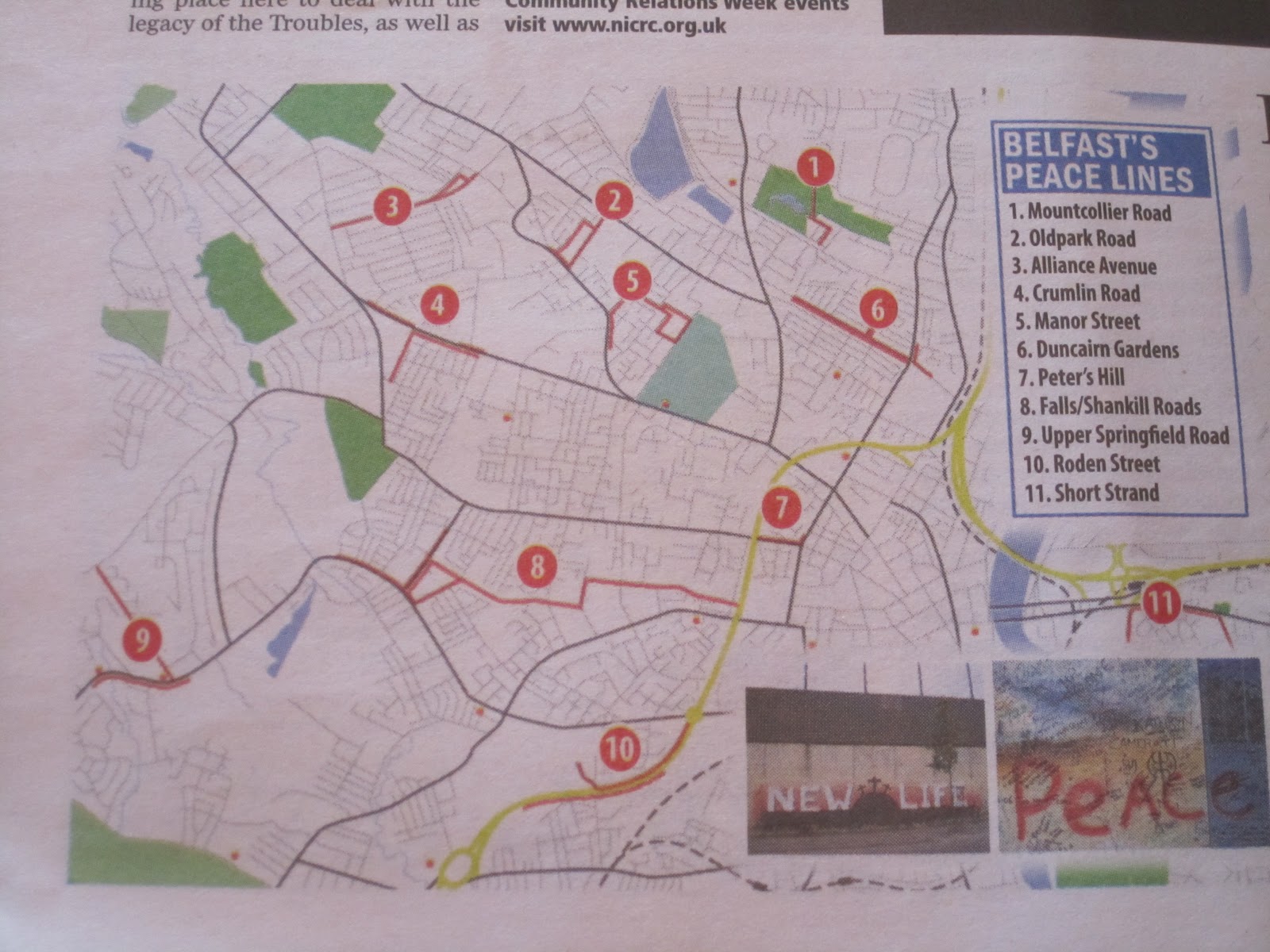 |
| Here's a map of Belfast's major "peace walls" - we passed through #8 |
 |
| The hands are labelled "proud," "defiant," "welcoming" |
 |
| One of the several well known UVF (Ulster Volunteer Force) groups |
So now we get to see the other side of the equation. British Loyalists have been in Ireland/Northern Ireland for centuries, in particular since the late 1600s/Battle of the Boyne (Loyalists have continued marches celebrating the Boyne and the victory of England over Ireland up until present day). They enjoy being part of the UK, and have deep roots here.
In the 1916 Easter Uprising and the surrounding uprisings in Ireland, the Ulster Volunteer Force was formed among the Loyalists to defend their neighbourhoods from attack and ultimately to support the UK - they were a key part of the defense of British Ireland, and probably a key reason the North remained with the UK. It's the other side of the coin to some IRA members: defence of one's neighbourhood/neighbours. The UVF, being a loyalist group, was drawn upon to form British Army units in various wars, particularly WWI. So much of their identity and symbols are military, and legitimately so (as there were army brigades full of UVF members) - though it's a bit confusing because these symbols are used to legitimize their purely domestic & political actions as well (defence of neighbourhoods from IRA attack, etc.).
The Loyalist brigades in the army were hit hard. At the Battle of the Somme in WWI, the unit from the Shankill neighbourhood went "over the top" and only 76 out of 760 men survived. Pretty much a whole generation wiped out in one rush - ample reason for some war memorials. This was around the same time that Republican forces in Ireland, sensing a weakened England (from WWI), began uprisings for independence - to the loyalists, another force attacking the UK to defend against.
 |
| Partially-complete Loyalist mural in tribute to UVF army units in WWI |
While vigilantism is not something modern nations should endorse, it's not hard to see why some Loyalists felt it necessary.

There's a very strongly-worded piece of text posted at that memorial. Part of it reads as follows:
"For although many good friends were lost and injured on that fateful day, the people of West Belfast and, indeed, Ulster, emerged stronger and even more resolute, to defeat the pure evil that is Irish Republicanism, once and for all!This, a couple of hundred metres from a "war memorial" dedicated to the IRA. No wonder there's a wall!
We all know that Republican politicians would have us sit with them in negotiation.
We all know that they would have us now believe that theirs is a message of peace, and those militants with whom they associated in the past were part of an army!
But the Irish Republican Army was not an army, nor were they so-called freedom fighters.
They were a homicidal, guerrilla grouping! A criminal organization devoid of conscience! An organisation which fouls the decency of humanity in every sense and on every level!
Yes, we know the IRA for what they were, and what they remain, a sectarian murder gang whose targets were easy, innocent and vulnerable men, women and children."
 |
| Pretty much sums up the hard core Loyalist position |
 |
| Being British subjects & having a vote was valued |
 |
| Hard to spot, but on the far right: "A protestant farmer's wife protects her husband against sectarian attack from across the border" |
 |
| Another good summary of some sentiment in the area |
 |
| List of those killed in the four major bombings in the area |
 |
| Commemorating the Percy Street bombing by Germany |
While that was certainly an enlightening tour, we didn't have any solutions for Northern Ireland's problems, and needed something less draining to do. So we hit the botanical gardens at the university.


And saw some nice university buildings.
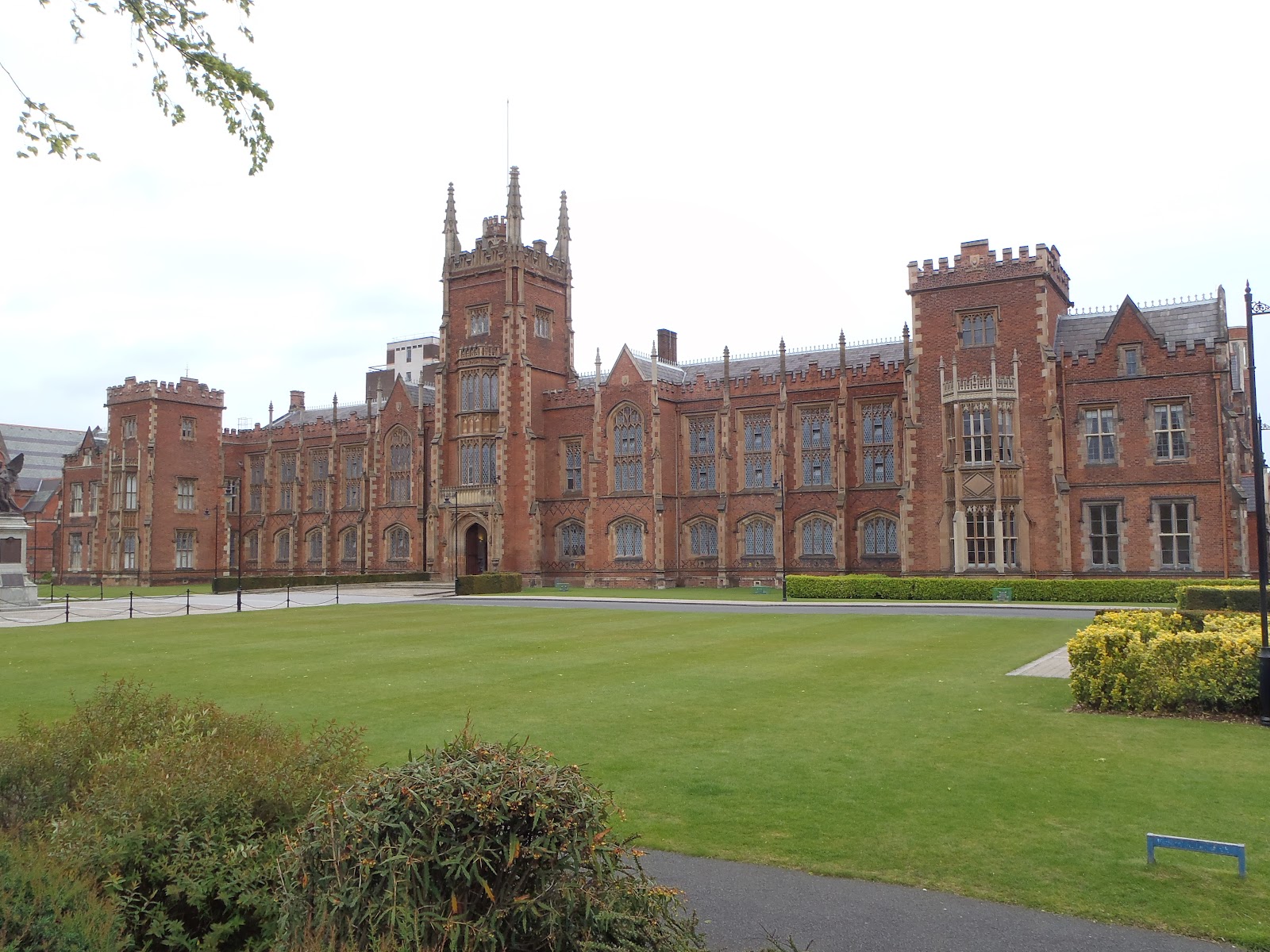
And that evening, went to see Ken Haddock at the Empire near the university. Great little venue - like a one-quarter scale commodore, but a real pub. And Ken Haddock has a voice like a titan, and pulls off some wonderful classic rock/blues/R&B every Sunday.
(In fact, if you're ever in Belfast, avoid the plastic and identical global chain stores downtown and take a walk down Botanic Avenue, through great independent shops and cafes. Stop at Maggie Mays for inexpensive but tasty comfort food, and take in a show at the Empire. Good times.)
 |
| Empire - the pub & stage are downstairs |
Welcome to Belfast
While we were still in Dublin, I was browsing a Lonely Planet Ireland travel guide, looking for Belfast tips. The first sentence in that section said something about Belfast being, "Once on the list of B's to avoid including Baghdad, Beirut, and Bosnia..." At the time, I thought this was a bit dramatic. When looking at reviews of our hotel before booking, I noted a comment something like "The huge loyalist mural outside the hotel is a bit of a deterrent." Similarly, I didn't think much of it at the time.
 .
.


Then we went to Derry and learned a lot more than we could have imagined about the conflict in Northern Ireland. You may have already read Chad's post about our experience in Derry. As an aside, this is a picture we took on our walk to the train station on the way out of town. Clearly the Derry/Londonderry naming debate is not yet settled. You can see the name has been changed back and forth a number of times.


Long story short, by the time our train pulled into Belfast, I was curious about what we would be in for. This was the mural that greeted us next to our hotel, right out of the train station. Hmmmm.


Mural aside, this is, literally, a banner year for Northern Ireland. Everywhere in the city there are banners proclaiming "2012: Our time, our place". As Chad pointed out in an earlier post, it is clear that a huge amount of British money has been invested in revitalization. The Olympics are on, and it's very clear London is working hard to make the rest of the UK feel involved. The Irish Open is being held in Northern Ireland this year for the first time in several. And unless you manage to avoid all mainstream media, you'll also know that this is the 100th anniversary of the Titanic sinking. The Titanic was built in Belfast, so the city is capitalizing on that with a huge new Titanic 'Experience'.
We spent our first day out of the conflict and exploring the downtown core and the newly built and quickly expanding Titanic Quarter.
The first thing we happened upon was the Ulster Hall - the town's 'community hall' - which was celebrating it's 150th birthday that day. We took a free tour to hear about its history (it was interesting - to me at least - that the majority of people taking the tour were locals, and they spoke throughout about the things they had seen and done in the hall). Ulster Hall has had many an act perform here, such as the Red Hot Chili Peppers. Chad was excited to learn Led Zeppelin premiered Stairway to Heaven here.
 |
| Nicely restored hall - the windows were bricked over during the Troubles in case a bomb went off outside (which did happen - a car bomb seriously damaged the hall), but now have glass and there's a nice light in the room. |
 |
| Chad has a piece of cake in celebration of the Ulster Hall's birthday. |

Next we headed on to Belfast City Hall where there is a London 2012 big screen set up for Belfast's people to share in the Olympic experience.


And then over the River Lagan for some public art and views of the city skyline.


It is obvious that a lot of money has been invested in the Titanic Quarter, with more to come. Right now it's a bit like Yaletown, with lots of townhouses and open spaces. The Titanic Experience sits in front of space formerly the Harland and Wolff shipyards where the Titanic and her older sister Olympic were designed and built. You don't hear much about the RMS Olympic, but she was built before Titanic and had a long and successful 24-year career as a transatlantic ocean liner with the White Star Line before Titanic came along and a troop ship in World War I (when she was fired on by a U-boat, which missed, and then ran down the U-boat, sinking it).
The Titanic Experience is impressive from afar.

We didn't get to go in (okay, I didn't get to go in, Chad didn't intend on joining me for the horrendous 15 quid admission price), as admission was completely sold out for Sunday. So we took a wander of the grounds instead.
Once we had our fill of Titanic, we went in search of - and found - some craft beer from local breweries. Here I survey the options.
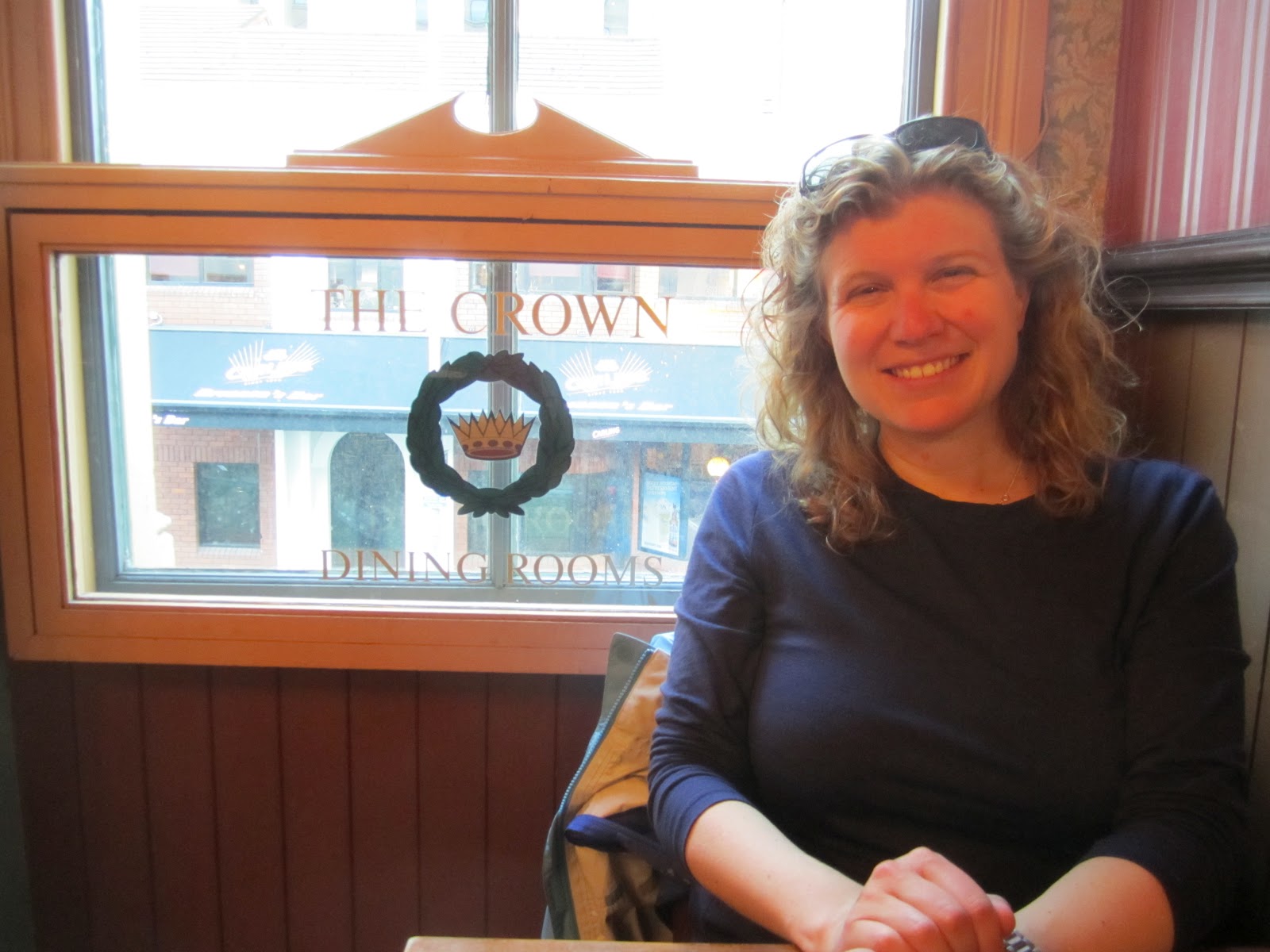
And finally, we went to the Crown pub (upstairs dining room) for dinner. It's a beautiful spot - their website claims it is the most beautiful pub in Northern Ireland.

When we left Derry, our host at the hostel we stayed at (a New Zealander who lived in Belfast for many years) said that Belfast "is a city that does not fall into your lap". I think this is very true, but we still had a good first day wandering the city streets. I'll let Chad tell you about the second!
The Titanic Experience is impressive from afar.

We didn't get to go in (okay, I didn't get to go in, Chad didn't intend on joining me for the horrendous 15 quid admission price), as admission was completely sold out for Sunday. So we took a wander of the grounds instead.
 |
| Harland and Wolfe gantry cranes still loom large. |
 |
| The two grey buildings in the middle are the site from which Harland and Wolfe ran their ship building empire. |
 |
| They have paved over where Olympic and Titanic were built and outlined them on the pavement. We were surprised by how narrow they were. Titanic's hull sat where this Plexiglas now stands. |
 |
| If you look closely, you can see alternating planks and turf where Titanic is outlined. Sorted by class, the planks represent those who survived and the turf those that died in the sinking. As you move from first to third class, the amount of turf increases greatly, but it also demonstrates how most of the crew went down with the ship, something not often talked about. |
Once we had our fill of Titanic, we went in search of - and found - some craft beer from local breweries. Here I survey the options.
 |
| The stout from College Green Brewery was delicious. The one from Hilden was... okay. |
And finally, we went to the Crown pub (upstairs dining room) for dinner. It's a beautiful spot - their website claims it is the most beautiful pub in Northern Ireland.
When we left Derry, our host at the hostel we stayed at (a New Zealander who lived in Belfast for many years) said that Belfast "is a city that does not fall into your lap". I think this is very true, but we still had a good first day wandering the city streets. I'll let Chad tell you about the second!
Friday, May 11, 2012
Bushmills and the Giants Causeway
More good times in the vicinity of Derry. I'm sorry, Londonderry. Or... well whatever. I definitely recommend the area - beautiful little downtown, nice bit of water, and it's the gateway to the best-known Northern Irish coastal sights.
Sarah and I took a little evening walk in the wind and rain across the brand new pedestrian bridge from downtown to the former army/police barracks which are being transformed into fancy condo housing.

The next morning we strolled through the sun to the train station, and took a train to Colerain, about 45 minutes away.

Then some extremely helpful Ulster Bus people put us on a special bus to the town of Bushmills. That's right, Bushmills of Bushmills Irish Whiskey fame.
Bushmills is a tiny, cute little village. Yet check out their police station above. It looks like a 21st century concentration camp headquarters! Remnants of the Troubles.

Sarah and I went on a distillery tour at Bushmills. It's a bit touristy and they don't give you access to anyone who can answer real distilling questions, but they do take you through the working factory, unlike most other such "tours" (ahem, Guinness). I say factory because, well, it is a factory, just like a large-scale brewery. Not a lot of art going on here, just pipes and pumps and measuring tools. They produce a LOT of whiskey, and they only make a few types, so it's all about volume.
(Unfortunately Bushmills, in addition to many more of the world's best-known brands of alcohol, is owned by Diageo. And I'm feeling decidedly anti-Diageo these days. You can expect a post over on the hoplog blog about this in the near future.)
 After the tour, we had a picnic lunch in a cool wind on some nearby picnic tables.
 Then it was off on an approx. 4 km walk along a nice bike path to the Giants Causeway - the most popular tourist attraction in Northern Ireland. It was sunny, but extremely windy along the coast. In peak season, a tourist train will give you a ride there on this narrow gauge railway.

 After a few kilometres of golf courses and grasslands, we got to the coast which was stunning. The wind had whipped up some significant surf, which looked brilliant in the sunlight.
 Sweet manor house on the lovely coast.

 Greenery and wildflowers are finally starting to bloom in Ireland. So late this year!
 We made our way past the half-constructed 36 million-pound-sterling new visitor center and down to the Giants Causeway proper. The surrounding cliffs and coast are gorgeous, though the Causeway itself is a bit small to be calling itself "Giant." It's a collection of hexagonal basalt columns, formed by long, slow cooling from the molten state. Neat looking, and crawling with tourists.

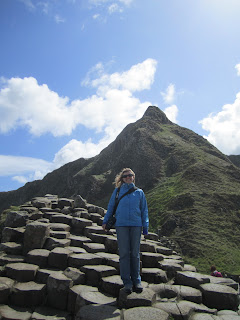


After a day of sun, our return bus showed up a few minutes after it started raining - all in all a well-timed day out on the Northern Irish coast.
Sarah and I took a little evening walk in the wind and rain across the brand new pedestrian bridge from downtown to the former army/police barracks which are being transformed into fancy condo housing.

The next morning we strolled through the sun to the train station, and took a train to Colerain, about 45 minutes away.

Then some extremely helpful Ulster Bus people put us on a special bus to the town of Bushmills. That's right, Bushmills of Bushmills Irish Whiskey fame.
 |
| The police station tries to duplicate the Berlin Wall |

Sarah and I went on a distillery tour at Bushmills. It's a bit touristy and they don't give you access to anyone who can answer real distilling questions, but they do take you through the working factory, unlike most other such "tours" (ahem, Guinness). I say factory because, well, it is a factory, just like a large-scale brewery. Not a lot of art going on here, just pipes and pumps and measuring tools. They produce a LOT of whiskey, and they only make a few types, so it's all about volume.
(Unfortunately Bushmills, in addition to many more of the world's best-known brands of alcohol, is owned by Diageo. And I'm feeling decidedly anti-Diageo these days. You can expect a post over on the hoplog blog about this in the near future.)
 |
| Sarah has a wee dram of factory-exclusive 12-year-old before lunch |
 |
| Chad tries to remember if he put his bottle of 16-year-old Bushmills in an accessible spot in the storage locker or not |


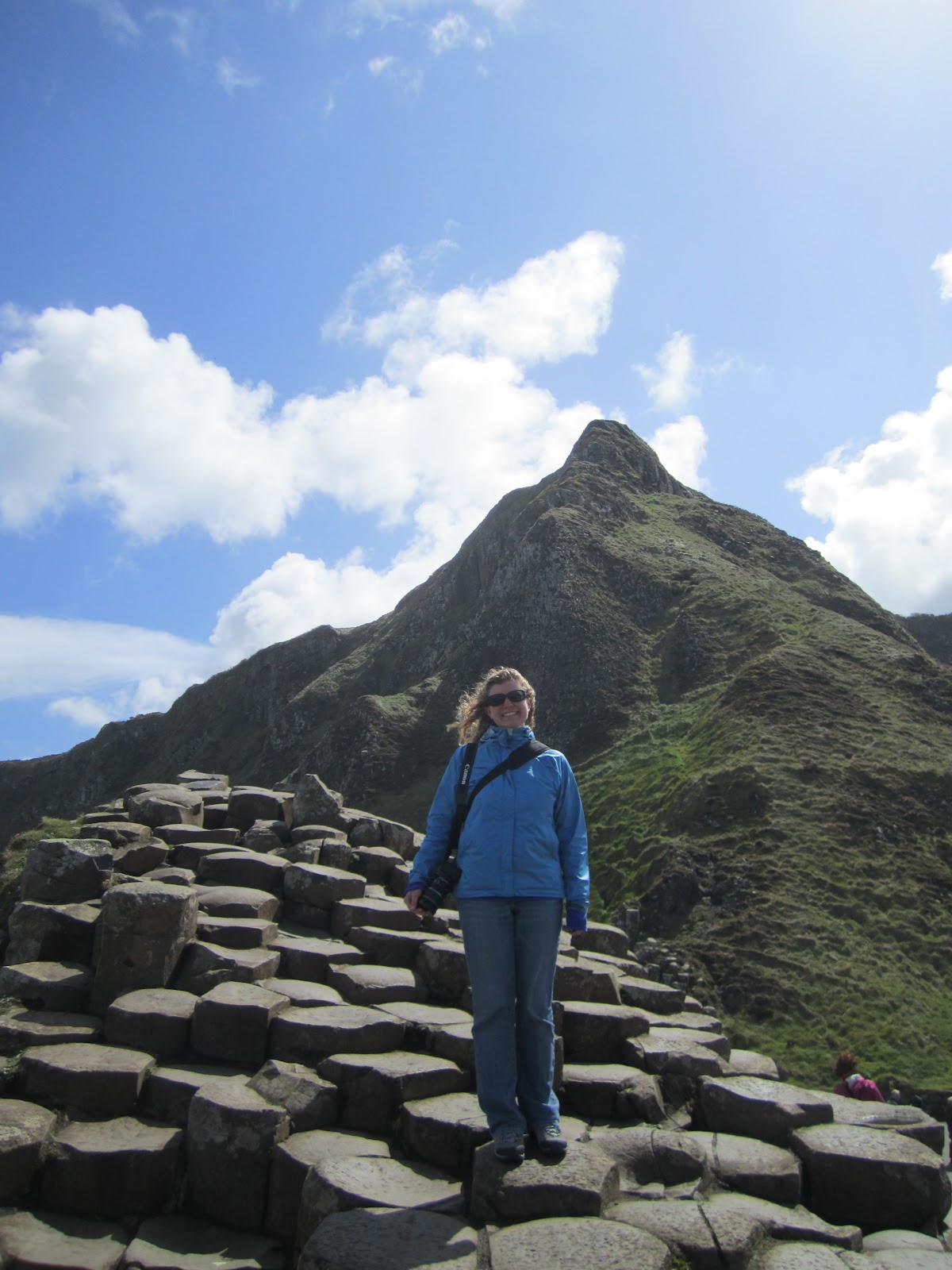


 |
| Chad does his best "Karate Kid" crane style moves |
 |
| You feel a bit like you're in a game of Q-bert |

After a day of sun, our return bus showed up a few minutes after it started raining - all in all a well-timed day out on the Northern Irish coast.
Subscribe to:
Posts (Atom)