Less nerdy than usual.
First beer in the southern hemisphere: http://hoplogblog.blogspot.com.ar/2012/10/first-beers-in-southern-hemisphere.html
Mendoza, AR: http://hoplogblog.blogspot.com.ar/2012/10/mendoza.html
Bariloche, AR: http://hoplogblog.blogspot.com.ar/2012/10/bariloche.html
Enjoy!
Showing posts with label Valparaiso. Show all posts
Showing posts with label Valparaiso. Show all posts
Thursday, October 25, 2012

Monday, October 15, 2012
Mas Valpo
Another day in Valparaiso (nickname: Valpo)... another day in paradise? Maybe not quite, but we do really like this city. It's a bit quiet today, as it's a national holiday and many businesses are shut down today. Also worth noting is that apparently Valparaiso has a bit of a shady side; it is a port town after all. The guidebook, our hostel owner, and other travelers are full of warnings about where to avoid in the day time, where to avoid at night, where to watch your pockets, etc. We've felt safe during out time here, though of course we've been watching our stuff pretty closely and staying out of the areas that are obviously super sketchy (and they're pretty easy to spot). But on to more positive things!


We spent part of the afternoon at the impressive Museo Naval y Maritimo. For some reason, I love maritime museums, and this one did not disappoint.

We ended up spending most of the day walking about and going to the museum, so after resting up a bit we headed for dinner, which was accompanied by more craft beer. The local treat: Cerveza del Puerto.
 |
| Contemplating life and the city below from our third floor balcony. |
 |
| At the bottom, a mural of Salvador Allende. At the top, yet another campaign poster. It's election time here too. |
 |
| It was a bit odd to literally stumble on this sidewalk drawing of Kurt Cobain and Nirvana. There was a performance of several grunge tribute bands here last week, and this drawing must be related. Chad was very sad that we missed the shows. |
 |
| This arch was built for Queen Victoria's visit, as part of the attempt to impress her with Valpo. Our hostel owner described it as "like the Arc de Triomph, but smaller". Um, yeah. A lot smaller. |
 |
| We think these old school, trolley style busses are no longer used, but who knows? Maybe on work days. |
 |
| Outside the Chilean congress buildings. These massive and odd looking buildings were a Pinochet pet project, though not completed until after his reign ended, in 1990. Congress now sits here, about 120 km from Santiago (where the rest of government is). Apparently politicians find this a bit inconvenient and there is speculation that they will turn this building into a hotel and move Congress back to the big city. |
 |
| Chilean Naval headquarters. Yesterday this square was jam packed with cars and merrymakers. |
 |
| Heading up Ascensor Artilleria. More rickety than the last, if that's even possible. And the weeds growing between the tracks are not exactly confidence inspiring. |
 |
| Paseo 21 de Mayo, at the top of Ascensor Artilleria - totally worth the trip! |


 |
| Valpo has 15 ascensors, built between 1883 and 1916. Never mind rickety, this one is completely out of order. |
 |
| Chad going to battle. |
 |
| A stained glass panel of Chile. Why is part of Antarctica in that panel, you may ask? Well, according to the charts we saw today, Chile is claiming the tip of Antarctica as its own. I suspect Argentina may have a problem with that (never mind the rest of the world). |
 |
| This panel and the one below are maps from the late 1700s. A big chunk of North America is missing, as is a big chunk of Australia. And who are those guys at the bottom? Colon, Magellan, Copernicus, and Neil Armstrong. |

 |
| The museum also has a display for Los 33, the miners who were trapped underground a couple years ago and successfully rescued after 69 days. This is the capsule that brought them up. A success, and a great PR for the president, whose popularity was falling at the time. The connection: search and rescue personnel who first went down to check the miners were from the navy. |
 |
| Could it be a coffee that actually tastes like coffee?? |
 |
| A boat prow shaped to look like... a chicken? A pigeon? I think it may actually be a condor, which appears to be Chile's national bird. |
 |
| Lager on the left (not so good), Brown Ale on the right (might have been an accident, but sure was tasty!) |
Valparaiso
Off to the bus station and off to Valparaiso - Chile's oldest and most important port is only 1:30 to the west.
Stray dogs (and there are potentially more here than in Turkey, which is saying something) spend a lot of time conserving their energy by flopping down and napping wherever they feeling like it. Here's one at the bus station. Awww. They're surprisingly non-aggressive (that would take too much energy), and generally just hang out during the day, waiting for people to put their garbage out on the curb in the evenings, when they rip the plastic bags to shreds and chow down. Sometimes one will try to join you as you're walking, probably out of instinct to join your "pack," but that usually only lasts 1/2 a block.

Some of them really abuse the stray dog privilege, though - this bloated fella parked himself right in the middle of the bus lineup, not caring (or noticing) that hundreds of people had to step over him to board.

Getting to Valparaiso was pretty easy and fast, even though our bus was speed limited to 100 km/h and a loud alarm would go off if the driver exceeded that speed. We went through the longest vehicle tunnel I've ever been in, and through the white wine region of Casablanca, on the way to the coast.
Valparaiso is set on a huge natural amphitheatre surrounding a bay, and has been an important port for Chile since Europeans first arrived. The city is a huge jumble of houses cascading randomly down steep hills to the port and the water below, which makes for a unique looking town. To get to our hostel, we took one of the city's many old funiculars (ascensors) to the Cerro Conception neighbourhood, formerly where well-off British families lived.


We walked along some of the promenades lining the ascensor-top hills, then down into the old port, which is a bit sketchy and has some not-so-good areas.
Our hostel host told us about the statue of justice commissioned for Valparaiso's main courts. His story goes that it was commissioned long ago from a French guy, who spent a few months in Valparaiso and saw the corruption of the local courts firsthand (the wealthy and politically connected always prevailed, etc.). So he created a statue of justice with no blindfold - staring wide-eyed and straight ahead - and with the scales of justice tangled irretrievably under one arm. The local officials were shocked, but the artist excused the lack of blindfold by saying that justice needed to clearly see all available evidence before rendering a decision. I don't know how accurate that story is, but the statue is hilarious and exactly as described.
We also climbed the 162 "stairs of death" to a viewpoint and the Thomas Cochrane "museum". There are a lot of stairs like this around town, but this is probably the longest and straightest set.

Another story from the hostel host (true or not, who knows): Around the time of Chile's independence they realized they needed to have a great navy to survive, since the country averages about 175km wide but is 4000km long, and one of the long sides is coastline. Thomas Cochrane, a retired British naval officer, was hired to be the first admiral of the Chilean navy (Chile declared independence from Spain, so hiring a long time foe of Spain made sense.) Streets are named after him, and his naval exploits are celebrated. When Queen Victoria visited in later years, they told her that the famous Brit Cochrane had lived in a lovely house on a hill, which they kept as a museum - which of course he hadn't, but they wanted to impress her so they set up a temporary museum there. It's now a nice viewpoint from which to see the port (below).

When we got to the far end of the port, it was impossible not to notice thousands - actually tens of thousands - of people heading along a street past the port. (It was a big holiday weekend in Chile.) So we went with the flow, and it turns out a huge Afro/Latin cultural festival was taking place all along this road, that hugged the port and waterfront for a few kilometres. Lots of very well-drilled afro/latin equivalents to marching bands performed all down the street, with Brazilian Mardi Gras style dancers in costumes and/or body paint.


It was pretty cool, with some great music, but we had heard that things got rowdy and the police had broken up some groups with tear gas the night before, so we decided to head out before things potentially reached that level again. We wandered back.

Back at the hostel, we rewarded our long day of walking by opening our emergency tetrapak of wine.

As we were heading out to dinner, we heard live music coming from a church around the corner. We popped in; 1/2 the church was filled with an enormous latin-influenced folk music ensemble, and they were incredibly good and having a lot of fun. I wish we had seen the whole performance! (They were part of the IX Festival de Musica Immigrante.)
I was super-impressed with the band, which was all-acoustic. It seemed to be a collection of volunteers, but they were very in sync and sounded wonderful. There were more musicians than a full symphony orchestra - a whole bunch of strings, about 10 guitarists, a half dozen accordions flutes/trumpets/saxophones and various other woodwinds, tons of percussion, singers, even two bagpipers.
After that sweet, donation-based musical pick-me-up, we grabbed dinner at a seafood restaurant, also featuring some live music (as many places here do).
I had a huge bowl of shellfish in tasty fish broth for dinner - I had been craving seafood for some time, and this was just the ticket.
And to make my night complete, the acoustic guitar playing singer inserted an acoustic version of "Fade To Black" (by Metallica) in Spanish, though I think I'm the only one in the restaurant who noticed. Rawk!
Stray dogs (and there are potentially more here than in Turkey, which is saying something) spend a lot of time conserving their energy by flopping down and napping wherever they feeling like it. Here's one at the bus station. Awww. They're surprisingly non-aggressive (that would take too much energy), and generally just hang out during the day, waiting for people to put their garbage out on the curb in the evenings, when they rip the plastic bags to shreds and chow down. Sometimes one will try to join you as you're walking, probably out of instinct to join your "pack," but that usually only lasts 1/2 a block.

Some of them really abuse the stray dog privilege, though - this bloated fella parked himself right in the middle of the bus lineup, not caring (or noticing) that hundreds of people had to step over him to board.

Getting to Valparaiso was pretty easy and fast, even though our bus was speed limited to 100 km/h and a loud alarm would go off if the driver exceeded that speed. We went through the longest vehicle tunnel I've ever been in, and through the white wine region of Casablanca, on the way to the coast.
Valparaiso is set on a huge natural amphitheatre surrounding a bay, and has been an important port for Chile since Europeans first arrived. The city is a huge jumble of houses cascading randomly down steep hills to the port and the water below, which makes for a unique looking town. To get to our hostel, we took one of the city's many old funiculars (ascensors) to the Cerro Conception neighbourhood, formerly where well-off British families lived.
 |
| Ascencor Conception - wooden and rickety since 1883! |
 |
| Not sure what happens if the cable breaks - at least there are two cables |
 |
| Sarah loves ascensors |
 |
| View from the top of the ascensor - Chilean naval base as well as a container terminal |
 |
| View through the side window of our hostel porch |


We walked along some of the promenades lining the ascensor-top hills, then down into the old port, which is a bit sketchy and has some not-so-good areas.
 |
| Romantic promenade |
 |
| Not a lot of wiring has gone underground here - yikes |
 |
| An odd "fake museum" for tourists, in Bavarian style |
Our hostel host told us about the statue of justice commissioned for Valparaiso's main courts. His story goes that it was commissioned long ago from a French guy, who spent a few months in Valparaiso and saw the corruption of the local courts firsthand (the wealthy and politically connected always prevailed, etc.). So he created a statue of justice with no blindfold - staring wide-eyed and straight ahead - and with the scales of justice tangled irretrievably under one arm. The local officials were shocked, but the artist excused the lack of blindfold by saying that justice needed to clearly see all available evidence before rendering a decision. I don't know how accurate that story is, but the statue is hilarious and exactly as described.
 |
| Umm, can I be tried in a different court? Please? |
We also climbed the 162 "stairs of death" to a viewpoint and the Thomas Cochrane "museum". There are a lot of stairs like this around town, but this is probably the longest and straightest set.

 |
| Sarah cranks it up Berg Lake Trail style [Sarah: you'll notice that Chad is already at the top taking the photo!] |
Another story from the hostel host (true or not, who knows): Around the time of Chile's independence they realized they needed to have a great navy to survive, since the country averages about 175km wide but is 4000km long, and one of the long sides is coastline. Thomas Cochrane, a retired British naval officer, was hired to be the first admiral of the Chilean navy (Chile declared independence from Spain, so hiring a long time foe of Spain made sense.) Streets are named after him, and his naval exploits are celebrated. When Queen Victoria visited in later years, they told her that the famous Brit Cochrane had lived in a lovely house on a hill, which they kept as a museum - which of course he hadn't, but they wanted to impress her so they set up a temporary museum there. It's now a nice viewpoint from which to see the port (below).

 |
| Looking toward the upscale resort town of Vina Del Mar |
When we got to the far end of the port, it was impossible not to notice thousands - actually tens of thousands - of people heading along a street past the port. (It was a big holiday weekend in Chile.) So we went with the flow, and it turns out a huge Afro/Latin cultural festival was taking place all along this road, that hugged the port and waterfront for a few kilometres. Lots of very well-drilled afro/latin equivalents to marching bands performed all down the street, with Brazilian Mardi Gras style dancers in costumes and/or body paint.
 |
| People swarming through the port, with tall stages in the background |
 |
| Music and dancing alongside the container terminal |


It was pretty cool, with some great music, but we had heard that things got rowdy and the police had broken up some groups with tear gas the night before, so we decided to head out before things potentially reached that level again. We wandered back.
 |
| Tourist boat port with some boat pilots being ferried to shore |
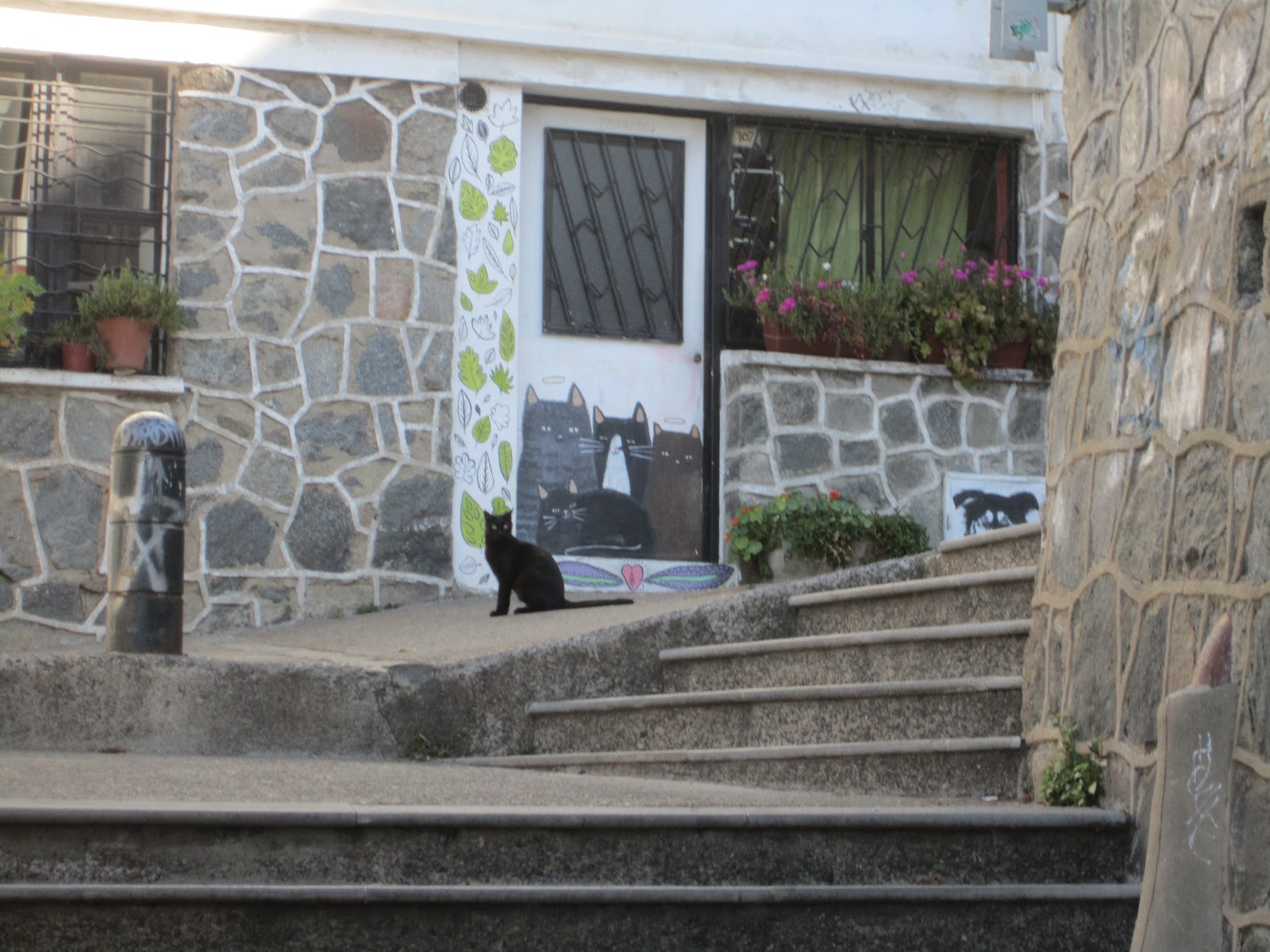 |
| Cats are not nearly as common as dogs |

Back at the hostel, we rewarded our long day of walking by opening our emergency tetrapak of wine.

As we were heading out to dinner, we heard live music coming from a church around the corner. We popped in; 1/2 the church was filled with an enormous latin-influenced folk music ensemble, and they were incredibly good and having a lot of fun. I wish we had seen the whole performance! (They were part of the IX Festival de Musica Immigrante.)
 |
| Ensamble Transatlantico de Folk Chileno |
I was super-impressed with the band, which was all-acoustic. It seemed to be a collection of volunteers, but they were very in sync and sounded wonderful. There were more musicians than a full symphony orchestra - a whole bunch of strings, about 10 guitarists, a half dozen accordions flutes/trumpets/saxophones and various other woodwinds, tons of percussion, singers, even two bagpipers.
After that sweet, donation-based musical pick-me-up, we grabbed dinner at a seafood restaurant, also featuring some live music (as many places here do).
 |
| Chad and his first pisco sour - the Chilean national cocktail, though Peruvians also claim they invented it |
I had a huge bowl of shellfish in tasty fish broth for dinner - I had been craving seafood for some time, and this was just the ticket.
 |
| Nothing but fish. Yum. |
And to make my night complete, the acoustic guitar playing singer inserted an acoustic version of "Fade To Black" (by Metallica) in Spanish, though I think I'm the only one in the restaurant who noticed. Rawk!
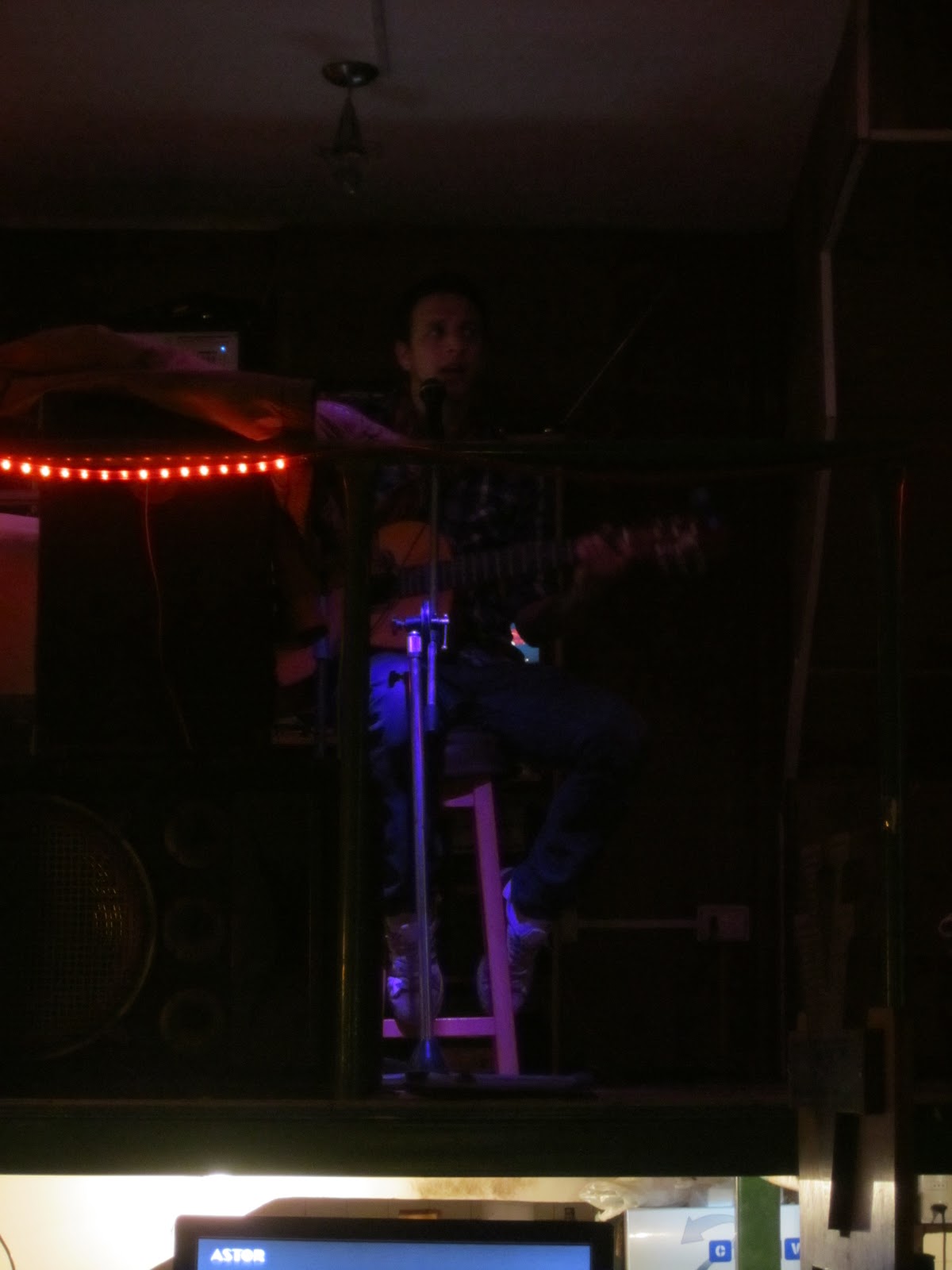 |
| It's never too acoustic or too soft for... Metallica? |
Subscribe to:
Posts (Atom)