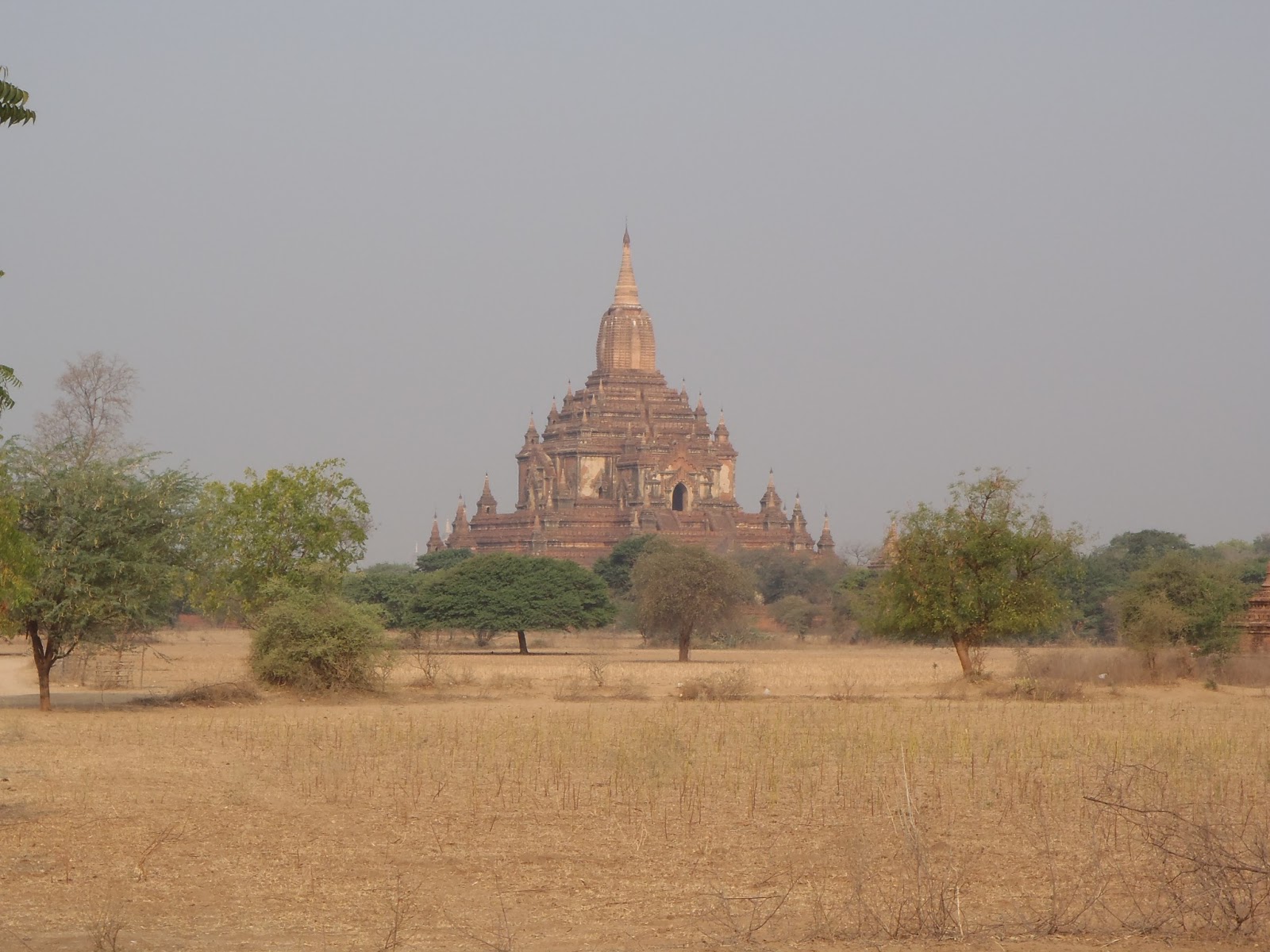
The Bagan temple area is probably the most famous tourist pilgrimage in Burma. And for good reason. If you've ever seen photos of hundreds of ancient temples and stupas jutting out of a nearly unending forest landscape before finally fading into the mist... well, that's here! We visited near the peak of hot season, so it's less lush and green - in fact it's decidedly sandy and dusty - and the "mist" is actually haze that limits visibility to a few kilometres. But none of that can take away from grandeur of the area. An ancient capital, almost all of the thousands of stupas and temples in Bagan were built between about 1000 and 1260 AD.

And what better way to see it than from your own personal chariot? Actually, our tour was really wonderful - our driver/guide was born in the area, was very knowledgeable and took us to great temple highlights while avoiding many of the crowds. (Though there's no avoiding the swarms of children at every major site who pursue you loudly while seeking postcard sales - and so the ill effects of tourism in Burma begin.) The horse set a relaxed pace which gave us a chance to soak up the sights, while the canopy provided essential shade.
Sarah loved lounging in the back on the Angry Birds cushions - I think she was just happy she didn't have to saddle up and ride the horse.
And we're off!
This is just the gatehouse of the first (small) temple we visited. Wow.
Most temples of any size contain an embarrassment of art in the form of painted walls, bas-reliefs and statuary.
Burmese puppets are somewhat famous, and a common tourist souvenir for sale at the more-frequented temples. These ones seem to be extras from The Blair Witch Project.
A pause while the cattle jam clears up, and then we're off again.
We finally got to climb up two flights of stairs for a view of the flat Bagan plains.
Yep, as far as the eye can see in every direction, nothing but temples.
A popular tourist area for monks, too. (To me, pilgrim + camera = tourist.)
And they just keep coming.
Typical of every temple of any size - huge gold Buddha statues, wall paintings, the works.
The oldest stupa in Bagan is right on the banks of the Irrawaddy - a big gold-covered blob dating to 300 AD. Also the least interesting stupa in the region.
Another teak monastery lurking on a back road - our guide wasn't sure how old it was, but according to his grandparents (who had stories of its origin handed down to them from ancestors), it could be as old as 700 years. Impressive in any event.
And complete with wooden deer!
Ho hum, just another big temple covered in Buddha carvings, each in its own sconce.
We climbed up a couple of larger temples for more views of the surroundings. The landscape is truly saturated with towers in all directions.
As the sun headed toward the horizon, we approached a huge pyramid-like temple of red brick. The Mayans have nothing on the ancient Burmese!
I loved this place - it's unabashedly enormous, and feels oddly cozy while also making you feel insignificant.
Then it was time for Bagan's major tourist pastime: sunset viewing. The challenge is finding a place with enough height for a view that isn't also crawling with fellow tourists. Our guide did a bang up job, taking us to a smaller and less-populated temple with a rooftop view.
Next door to our sunset seats, the massive dome of a major stupa was completely encased in all-bamboo scaffolding (complete with internal stairs all the way to the peak) so that the top 1/3 could be re-coated with gold leaf.
Everywhere we looked - temples and towers. We could see many of the bigger temples we had visited.
And finally, a great sunset shot. The sun did not get much further toward the horizon than this before it "set" well short of the hills, completely buried in thick smoke and haze.
The next day we only wanted to see a couple of temples more, so we decided to...
...rent bikes! A nice option since Bagan is so flat. But even starting out at 7:30am didn't allow us to beat the heat for very long. By 8:30am it was seriously hot, and after 9:00am we started watching the clock, wondering how long we'd last. We returned by 10:30am, hot and sweaty and ready for a dip in the pool at our wonderful hotel.
Another challenge was leaving the pavement, which was necessary to reach the temples we sought. Some parts of the road were hard-packed dirt, but many sections were soft sand that did not provide adequate buoyancy for our narrow-tired townie bikes.
Just another enormous temple in the morning sun, the second-tallest in Bagan and one of the most richly decorated.
All the ancient temples contain a single square interior hallway so that you can "walk around the temple" on the inside. There's usually a really big Buddha statue in the middle of each interior wall. It's cool and shady in the hallways.
This temple featured some wacky-looking characters.
But I tried not to look too wacky for this artsy morning-sun shot.
On any surface that hasn't fallen off or been defaced there are incredible, detailed paintings, both of gods demi-gods and legends, as well as huge murals depicting every aspect of ancient life.
We biked though some more soft sand to a tall temple with a large, flat roof and great 360-degree views.
Our route took us from the big temple on the right, down the sandy road in the foreground to the spot where this photo was taken.
Temple viewing accomplished! A quick pedal through a native village blaring ear-splitting traditional music over loudspeakers and we were back in our base of New Bagan.
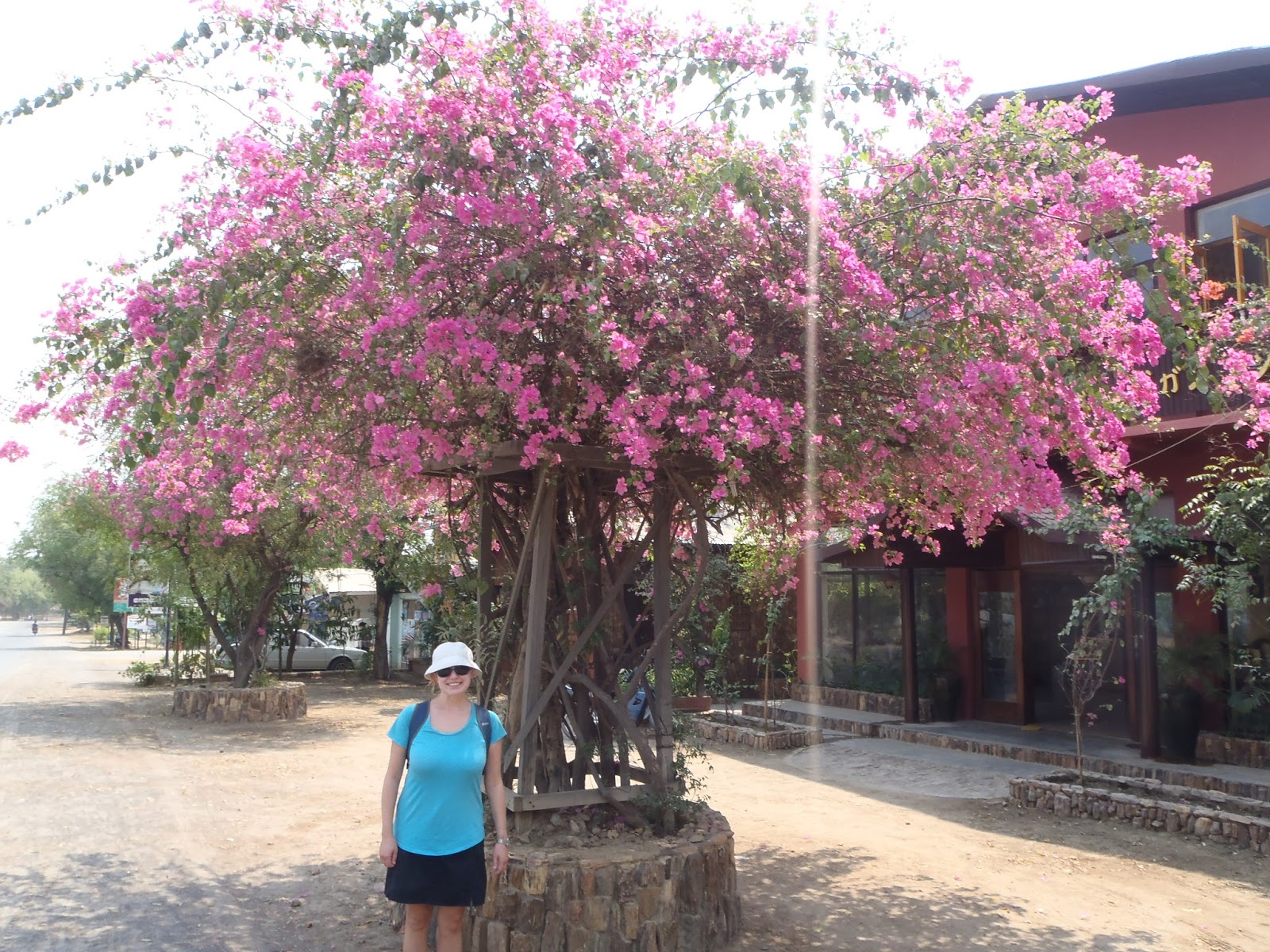
But there's more to do than look at temples. New Bagan was surprisingly OK to stroll through, in a rural beach-town-with-no-beach kind of way.
Bagan is also known for its handmade lacquerware, so we went to a very organized and tourist-friendly "factory". Lacquerware is made from strips of bamboo which are tucked together (no fasteners) in the shape of cups, bowls, etc. The bamboo construtions are then coated and impregnated with lacquer from the "lacquer tree" (not sure what we'd call it) - a type of natural varnish. This hardens the item and sticks the bamboo strips together. The lacquer is cured in a cool basement for a week between each coat and sanding - many coats are applied, for durability. Then different colour paints are applied, and designs and scenes are created by hand etching. Traditionally the paints are red, yellow and green, from natural pigments. Alternatively the surface might be painted with a brush, but it's all done freehand. In the end you have a beautiful, durable, waterproof, heat-resistant and very light-weight item.

This skilled bamboo maker peeled several strips from an already-thin piece of bamboo, then tucked them into a circular shape to form...
...a bracelet for Sarah!
The curing cellar - all of the red, yellow and green art is the result of etching. The furniture pieces are particularly time consuming - a big chest of drawers could take 1 year to make.
All this temple viewing and lacquerware learning can make one thirsty - so how about a glass of refreshing avocado juice? It's lightly sweetened really is genuinely tasty.
OK, we can see why people travel to Bagan. You should probably go too.