Showing posts with label Myanmar. Show all posts

Friday, April 5, 2013

What's in a Name? Burma vs. Myanmar and Other Fun Facts

So what is it?  Burma or Myanmar?  Yangon or Rangoon?  We've used both in our posts, and depending where you are in the world you will hear one, or the other, or both.  From the mid-19th century to 1989, the name commonly used was Burma.  However, in 1989 the military junta decided to scrap 'Burma' and other British colonial names like Rangoon, and changed the country's official name to the Republic of the Union of Myanmar, and the capitol to Yangon.

The UN recognizes Myanmar as the country's official name, in part because it is more inclusive than Burma (the country's population is nowhere near 100% Burman).  But almost all the opposition groups - including Aung San Suu Kyi and the National League for Democracy, many ethnic groups, and nations including the US and the UK, use Burma.  The reason appears to be primarily because the name was changed by the junta without any reference to the will of the people.  In Burma itself, people seemed to call the country Myanmar or, more often, just 'my homeland'.  We use mainly Burma, but it's something to decide for yourself.

And with that taken care of, before we move on to Bangkok again, a few interesting facts we noted while travelling through Burma:
  • In a restaurant, if you want to get a server's attention, pucker up and make a kissing sound to call them over.
  • When passing something to someone else (money, your passport, whatever), use your right hand, and use your left hand to support your right elbow.  It's polite.
  • On the road, keep your wits about you.  As a British colony, Burma used to drive on the left.  But in 1970, the junta decreed that traffic would drive on the right (possibly for astrological reasons).  However, most cars are still right hand drive either because they are pre-changeover or because they were imported from Thailand, Japan, or Singapore.  Makes for some scary situations, especially when trying to pass on narrow, winding roads!
  • In 2005 the military relocated the capital of Burma from Yangon to Nay Pyi Taw, halfway up the road to Mandalay and considered a more strategic, central location.  An unnecessary move.  The city of Nay Pyi Taw was built entirely from scratch, over rice paddies, villages, and small towns, at an estimated cost of over $4 billion.  (It's staggering to consider how much health care and education that sum could have provided in this country.)
  • Ubiquitous tea houses are good options for inexpensive food and bottomless thermoses of free jasmine tea.
  • Maybe it was just peak season, but Burma has the biggest and tastiest papayas I have ever encountered.
  • Native dishes to try: mohinga (cheap noodle dish), salad containing pickled tea leaves, Shan-style noodles (slathered in peanut sauce).  Many soups contain dried and/or fermented fish, which can be a little pungent.  But the food is rarely spicy hot.

Thursday, April 4, 2013

Another Beer Geek Post - Burmese Toddy

Hot off the Hoplog blog presses:

Burmese Toddy

Enjoy!

Final Days in Burma

After several days relaxing and temple visiting in Bagan, it was time to head back to Yangon for our flight back to Bangkok.  Not excited about the idea of a questionably safe internal flight, and keen to avoid any more overnight busses (especially since the bus would drop us in Yangon at 4 am!), we decided on a day time bus ride through the countryside.

To our surprise, the first-class bus was both very nice and full of Burmese people - obviously not a popular way for tourists to travel but we found it a pretty good, uneventful trip.  In front of us sat a very nice English-speaking Burmese engineer and his school teacher wife who told us about their kids and made sure we didn't get left behind at the stops.  The only painful part was a two and a half hour shouted political speech (in Burmese) that was played at inescapably loud volumes over the bus TV and speakers.  [Note from Chad: the louder passages drowned out the cranked-up podcast I was listening to on earbuds]  Well, and then there was when the 10 pound bag of peanuts fell out of the compartment above us and exploded, leaving peanuts crushed into the carpet and rolling up and down the aisles.  Well, and also the part where the nice engineer didn't care (and seemed annoyed!) when some of his 1 L glass bottles of fish sauce fell out of the same compartment and beaned the 1-year-old peasant baby across the aisle in the head.   Maybe not entirely uneventful.

Our last bus ride of the year!!

We didn't get up to much on our last day in Yangon - there were warnings against tourists visiting certain areas of the city and much was closed because it was a holiday.  Just a few snapshots.

Burmese mail delivery - attach mail to clip to be hauled up to the apartment above.  How they get the right apartment I wasn't able to figure out.

We arrived back at our hotel to find that the partially-torn up sidewalk in front had been entirely torn up.  Not uncommon - Yangon is undergoing a lot of roadwork right now.

All over town people were hanging up this monk poster.  Hopefully they relate a happy and peaceful message!

Just another generator on the street, to help residents deal with the frequent power outages throughout  the city.  

So what did we think of Burma?  In a word: awesome.  The people were friendly, the sights are amazing, and it feels different than anywhere I've ever been.  I had read a lot of other travellers' accounts before we went, and it is easy to see that things are changing very quickly - there are ATMs that foreigners can use, many more people have cell phones, and there are a greater number of newer cars on the road, to name a few. There will certainly be some growing pains as the people, businesses, and government deal with the influx of investment, tourists, and friendly international relations (as an aside, right after we got back to Bangkok, Canada announced that it will open an embassy in Yangon this spring).  And (as discussed in Chad's previous post) the country obviously still has some serious issues.  But overall it was a great experience and I feel so lucky that we got to go when we did, particularly before things get much more Western.  You should go!

Tuesday, April 2, 2013

Monkzillas and Shattered Illusions

OK, here it is, probably the last long, philosophical (and pictureless) post about serious issues that I'll write on this trip.  Pour yourself a fresh cup of coffee and settle in...

(Mostly written in Yangon on our last day before leaving Burma.)

Canadians Registered Abroad


While travelling, we normally don't register with the Canadian consular service as "Canadians abroad," but here's a plug for doing so the next time you're out of the country.  You can fill out a form online, then the feds will know you're in a region if there's an emergency there, and they'll automatically let you know if anything worrying happens where you are.  We registered for Burma, given its history and present circumstances.

After our day-long boat cruise from Mandalay to Bagan, we checked into our hotel and Sarah got an automated email from the consular service, saying travellers should beware of "sectarian violence" in the Mandalay region of Myanmar.  We were in the Mandalay region!  We quickly looked up the news on the internet, and confirmed that there was trouble in and around Meikhtila, a city south of Mandalay (on the old road to Yangon). The service works!

The Riots


Now, about that violence.  First of all, southeast Asia holds the only Buddhist-majority countries we've visited.  Despite my limited experience and interaction with Buddhists, I was about to give a big thumbs-up to all Buddhists and the religion in general.  Prayer is personal rather than through groups or intermediaries, and it emphasizes reflection and meditation, self-improvement and freedom from desire, charity, and peace.  The temples are lovely and calm, and the Buddhists we've seen praying have all been "normal" nice people - not a drop of glassy-eyed religious fervor.  On top of that, people have been lovely to us in the region - and the people in Burma have been the loveliest and friendliest across the board.

Nothing more relaxing than a walk around a Buddhist temple

But like most things, I guess it's just not as simple as that.  Burma is ethnically very diverse - an ethnic Burmese majority, but with significant south Asian and Chinese populations, and many non-Burmese tribal groups (like the Shan) among others.  Similarly, Buddhism is the major religion, but there are significant minorities of Christians, Muslims and Hindus.  There are ethnic rebel groups still very active in the border regions of Burma, and historically there has been simmering religious antipathy.  Apparently the long-standing military government kept the Burmese-majority populace on its side by demonizing and stoking hatred towards ethnic and religious minorities.  With Burma starting to open up and release its firm grip on its people, there might be less official demonization of minorities, but it continues among the civilian population (apparently some prominent, radical Buddhist monks speak strongly against minorities, in tandem with racist groups) and there is less police/military presence to enforce proper behaviour through force (I don't think it's to the level of "power vacuum," but a blind eye is often turned to actions taken against minorities).  Suddenly people must be trusted to act properly of their own volition, after years of being told to hate other groups.

Which is perhaps expecting too much too soon, even of an ostensible Buddhist majority.  For example, a year or two ago there were anti-Islamic riots in a western border region where up to 200 Rohingya (a stateless Muslim group) were killed.  The government was criticized for its lack of intervention.

The day we took the train up to Mandalay, there was some kind of dispute in Meikhtila, between a Muslim gold shop owner and his Buddhist customers.  Things turned ugly, and at some point a Buddhist monk was killed (among others) - we don't know who is responsible or what really transpired.  Monks are revered and respected in southeast Asia, so a story probably spread like wildfire through the town: "a Muslim killed a Monk!"  Radical Buddhist groups had been distributing anti-Muslim pamphlets and materials for weeks in the Meikhtila area, so tensions were high and waiting for a spark like this.  This news set off a mob of people in the town, who went on a rampage, burning mosques, Muslim homes and entire neighbourhoods where Muslims lived.  The mob (which included a significant number of monks, apparently) also scoured the town for the next couple of days, looking for Muslims to kill with machetes - the official toll is about 40 murdered to date, though "official" statistics in Burma are patently unreliable.  Two days later (after standing by while half the town burned) the province declared a state of emergency in Meikhtila and some neighbouring towns the violence had spread to.  Several hundred police moved in to Meikhtila and eventually restored some order through curfews and patrols of main roads.  Many Muslims obtained refuge in the secured soccer stadium; they were afraid to return home as the police did not patrol the side streets (and its questionable how much protection they would really provide to a minority in the face of an angry mob).

Our (Burmese) horse cart driver/guide in Bagan was visiting friends in Meikhtila during the initial riots, and had only returned to Bagan the day before our tour with him.  He said he spent two days not sleeping and not leaving their house, because they were so scared of the mobs.

While on our horse cart tour, we saw an American guy we had met while waiting in line for a Myanmar visa at the embassy in Bangkok.  The previous day he had taken a bus from Inle Lake to Bagan, which stops in Meikhtila.  He said that as far as he could see the police seemed to have things calmed down in the (significantly burned) town.  However, once in the outskirts and surrounding areas, there was no government control.  Their bus was forced to stop at a "checkpoint" set up by the mob groups just outside of town, and mob/paramilitary types boarded his bus with machetes, looked around, and then left.  Obviously searching for Muslims.  I would have dropped a load in my pants.

The (online, western) news reports mentioned how masked monks (!) accosted some journalists in Meikhtila and threatened them - one held a huge dagger to a journalist's throat until he gave up the memory card in his camera.  This is incredibly ironic, given that during the monk-led protests of 5 years ago, Burma's military regime attracted international outrage (and began to modify its stance) when photos and film of its violent suppression of monks were filmed and broadcast by journalists, at great personal risk.

The violence continued to spread south toward Yangon over the next couple of days.  This coincided with our bus trip back to Yangon from Bagan (gulp), which fortunately stayed on the new expressway, many kilometres from the old main road and the problem towns along it.  So we avoided any difficulty.

While we were back in Yangon for a day before flying to Bangkok, the US State Department warned its citizens not to visit certain neighbourhoods in the city, where some disputes/confrontations had occurred and some shops had closed their doors for fear of unrest.  (It was also a holiday, so some store closings were to be expected.)  This made us uneasy, but on the main streets downtown everything appeared normal.  We saw clearly-Muslim taxi drivers and shop owners, and nothing untoward was happening to them.  But again our radar likely missed any subtle undercurrents.

  • We found the first news of the riots through the New York Times and ABC News.  We were able to monitor the unrest as it spread, including when the United States warned its citizens to avoid certain areas of Yangon while we were still in Yangon.  Internet access was essential, though - otherwise we might not have heard anything before we left Burma.
  • Be sure to review this excellent and essential reading on the situation: from the Vancouver Sun and the Associated Press.

WTF?


So much for our naive view of all Buddhists as pacifist zen masters!  I'm confident that many/most people in Burma are frightened of these types of events, and at heart are peace-loving like the rest of us.  But there's a level of religious and racial anger and mistrust among many that we obviously weren't picking up.

The transition to less-totalitarian rule will be tough, but dammit, come on people!  It's essential you obtain balanced education and let go of old biases and hatreds.  More freedom from state persecution doesn't give you a licence to persecute others.  But this is easier said than done.

What really blows me away is the apparent participation of supposedly Buddhist monks in what appears to be genocide.  And I don't use that term lightly - roving gangs were openly trying to murder every available person of a specific religion.  While I suppose Buddhists aren't all inherently passive (after all, there were great Buddhist empires in this region 1000 years ago, which could not have existed without force), no true Buddhist would behave like this.  I imagine many of the "monks" participating were likely of the young and/or temporary kind.  In southeast Asia, many men become monks quite young in order to leave a life on the street, or to get an education along with a place to eat and sleep.  In Thailand, all young men are expected to become monks sometime before they marry, for 1-3 months - it's considered honourable.  So most monks one sees are "novices" - from pre-teens up to about 20 years old.  After the early 20s, it appears many monks leave the monastery, as we saw very few monks in the 20+ age range - it takes real dedication to live your entire life so austerely.  We also noted that the older monks (particularly ones in working monasteries and not on the monk speech-making circuit) seem to really have it together, while the novices were more likely to break the rules (actively begging money from tourists, smoking, other breaches of etiquette).

So my guess is that the "roving bands of monks" participating in these mobs are more likely to be young, poorly-educated, hot-blooded novices.  But I have no way of knowing.  It's hard to believe that certain popular, radical Buddhist monks have been fomenting hatred towards Muslims and other minorities, but they probably have a ready audience in young, disconnected novices fresh off the street.  (I note that vulnerable young people also seem to be the main targets of recruitment by other infamously radical religious and political groups.)  I think my own naive heart just wants some assurance that the friendly 80+ year old monk we met in Yangon isn't a heartbeat away from picking up a machete and stabbing someone for being Muslim.

It's tough to draw any conclusions from what we've heard.  News is spotty and incomplete.  I doubt there will be any sort of effective follow-up.  It's unclear where the radical anti-minority groups come from, or who is behind them.  And we can't read the Burmese alphabet or language, so we can't read, let alone identify, any pamphlets or signs as being anti-minority.  Who knows?

Sigh.  The world can be a wonderful place, and it can also be a scary place - following patterns of anger and violence that, as far as I have learned, are identical across cultures, geographies and religions, and across the centuries.  We need to keep striving to show people the correct path, the peaceful path.  Add education and a big dose of hope, and it's possible.

Good luck, people of Burma/Myanmar.  Don't give up, don't lose hope, and try your best to do the right thing.

Mt Popa

Off to the temple at Mt Popa via taxi.  But on the way, a stop at a roadside palm sugar "factory".  (Really a family-run place in a thatched building that shows the process to tourists, in addition to selling the sugar commercially on a small scale.)


Not only do they make palm sugar, they also grind sesame and peanuts into oil using ox-powered mills like this one.  (More peanuts - Sarah was understandably thrilled...) The child operator didn't spare the whip!


Tiny bamboo ladders are lashed to the sugar palms.  Some branches are lopped off and little jars are hung below the cut to collect the sap.  Each day someone climbs the tree, empties the jars and re-opens the cut so the sap keeps flowing.


The sap is put in kettles and boiled over fires fed by the removed palm branches.  A combination of boiling through evaporation and sun drying produces...


...palm sugar nuggets.  Also known as jaggery.  This was fairly light-coloured jaggery - darker, more caramelized versions are also available.  In addition to being a common ingredient in Burmese and Thai cooking, the Burmans traditionally eat a lump after dinner as a digestif.  It tastes a bit woody.  Pleasant.

They also make toddy (spontaneously fermented palm sugar) and palm wine (distilled toddy), but I'll cover that later in the Hoplog blog.


Next stop, the temple at Mt Popa (actually atop a volcanic plug on the shoulder of Mt Popa).  Reminded me of "St. Cyril's" monastery in For Your Eyes Only.


Not only is the location impressive, but the place is swarming with monkeys!  Very cute.  They do poop on the stairs, which are continuously cleaned by people looking for tips.  But they're so well fed by tourists who buy bundles of peanuts for that purpose that they are pretty calm and don't try to steal much from you.  (Yes, Sarah had to dodge both peanuts AND monkey poop on our climb to the top.)


Balance is not a problem for monkeys.


There aren't that many western tourists at Mt Popa, but the place is swarming with domestic tourists - by far the single most "touristy" place we visited in Burma.


Covered stairs make the climb much more pleasant.


The peak of Mt Popa and the village below.


Some of the tourist buildings at the bottom.


And back down, trying not to trip on one's longyi.  (Note: because of longyis and long skirts, all bicycle frames in Burma lack a top bar, which makes pedaling impossible unless you wear pants or shorts.)


A bundle of bananas along with a couple of standard Burmese metal lunch kits.  Everyone brings their lunch to work in these stacked bowls, usually swinging off the handlebars of their scooters and bikes.  You disassemble the kit and eat from multiple bowls - one containing rice, the others containing curries or other accompaniments.  You can mix and match with your friends, eating family style.


Family-style lunchtime with the metal lunchkits.


At the bottom of the hill is a little shrine to the 37 most famous nat (animistic spirits) that are worshiped alongside Buddha by many people, especially those with strong tribal connections.


Then it was back to Bagan and a final sunset dinner alongside the Irrawaddy.  It's a magical place.  The government is building new, modern palaces in the area (I don't know why) and even a modern spiral tower taller than all of the temples surrounding it.  One can only hope that they put the brakes on such misguided projects before the whole area is Disneyified and loses its charms.


Begin the Bagan

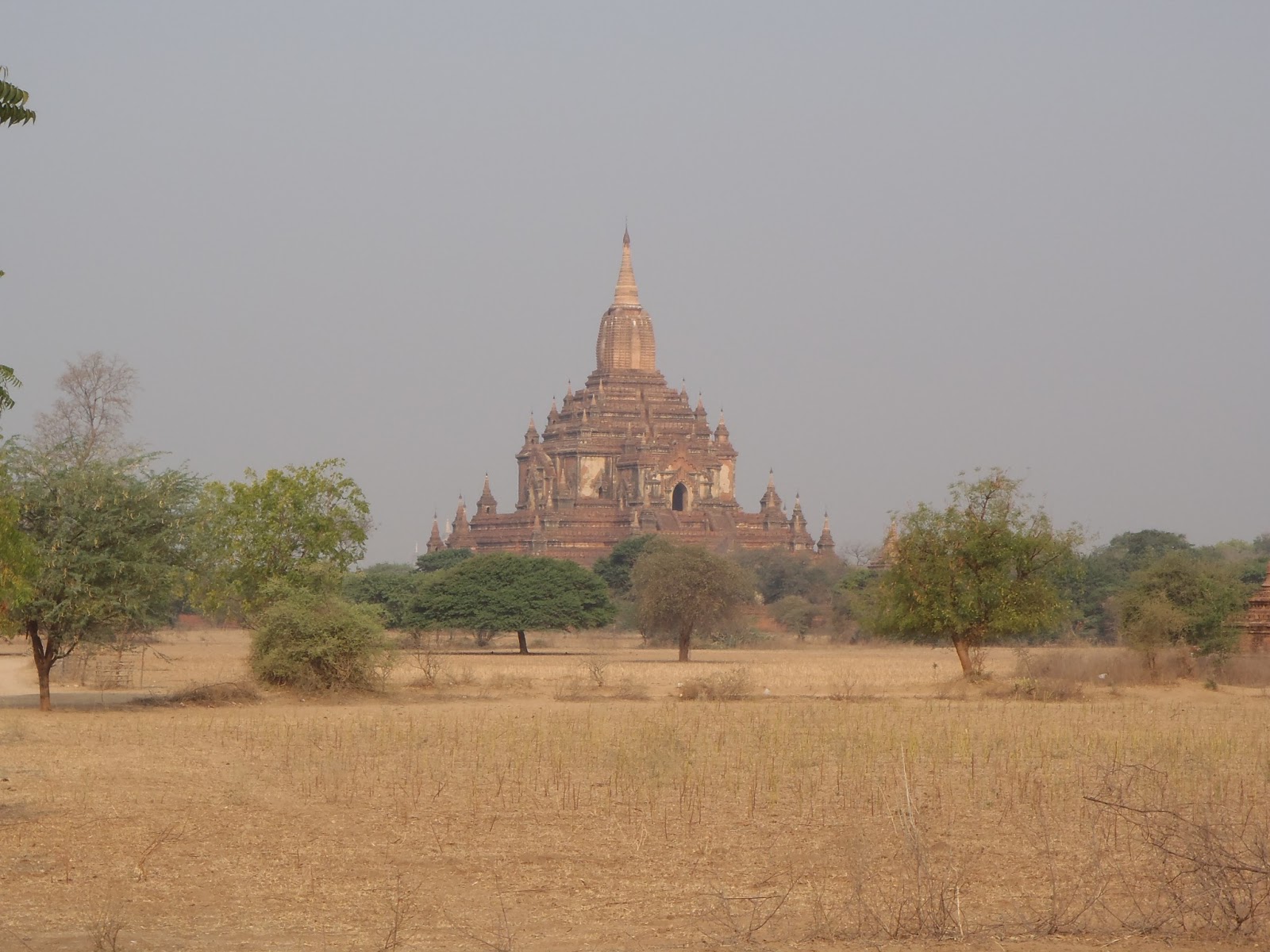
The Bagan temple area is probably the most famous tourist pilgrimage in Burma.  And for good reason.  If you've ever seen photos of hundreds of ancient temples and stupas jutting out of a nearly unending forest landscape before finally fading into the mist... well, that's here!  We visited near the peak of hot season, so it's less lush and green - in fact it's decidedly sandy and dusty - and the "mist" is actually haze that limits visibility to a few kilometres.  But none of that can take away from grandeur of the area.  An ancient capital, almost all of the thousands of stupas and temples in Bagan were built between about 1000 and 1260 AD.


And what better way to see it than from your own personal chariot?  Actually, our tour was really wonderful - our driver/guide was born in the area, was very knowledgeable and took us to great temple highlights while avoiding many of the crowds.  (Though there's no avoiding the swarms of children at every major site who pursue you loudly while seeking postcard sales - and so the ill effects of tourism in Burma begin.)  The horse set a relaxed pace which gave us a chance to soak up the sights, while the canopy provided essential shade.


Sarah loved lounging in the back on the Angry Birds cushions - I think she was just happy she didn't have to saddle up and ride the horse.


And we're off!


This is just the gatehouse of the first (small) temple we visited.  Wow.


Most temples of any size contain an embarrassment of art in the form of painted walls, bas-reliefs and statuary.


Burmese puppets are somewhat famous, and a common tourist souvenir for sale at the more-frequented temples.  These ones seem to be extras from The Blair Witch Project.


A pause while the cattle jam clears up, and then we're off again.


We finally got to climb up two flights of stairs for a view of the flat Bagan plains.


Yep, as far as the eye can see in every direction, nothing but temples.


A popular tourist area for monks, too.  (To me, pilgrim + camera = tourist.)


And they just keep coming.


Typical of every temple of any size - huge gold Buddha statues, wall paintings, the works.


The oldest stupa in Bagan is right on the banks of the Irrawaddy - a big gold-covered blob dating to 300 AD.  Also the least interesting stupa in the region.


Another teak monastery lurking on a back road - our guide wasn't sure how old it was, but according to his grandparents (who had stories of its origin handed down to them from ancestors), it could be as old as 700 years.  Impressive in any event.


And complete with wooden deer!


Ho hum, just another big temple covered in Buddha carvings, each in its own sconce.


We climbed up a couple of larger temples for more views of the surroundings.  The landscape is truly saturated with towers in all directions.


As the sun headed toward the horizon, we approached a huge pyramid-like temple of red brick.  The Mayans have nothing on the ancient Burmese!


I loved this place - it's unabashedly enormous, and feels oddly cozy while also making you feel insignificant.


Then it was time for Bagan's major tourist pastime: sunset viewing.  The challenge is finding a place with enough height for a view that isn't also crawling with fellow tourists.  Our guide did a bang up job, taking us to a smaller and less-populated temple with a rooftop view.


Next door to our sunset seats, the massive dome of a major stupa was completely encased in all-bamboo scaffolding (complete with internal stairs all the way to the peak) so that the top 1/3 could be re-coated with gold leaf.


Everywhere we looked - temples and towers.  We could see many of the bigger temples we had visited.


And finally, a great sunset shot.  The sun did not get much further toward the horizon than this before it "set" well short of the hills, completely buried in thick smoke and haze.

The next day we only wanted to see a couple of temples more, so we decided to...


...rent bikes!  A nice option since Bagan is so flat.  But even starting out at 7:30am didn't allow us to beat the heat for very long.  By 8:30am it was seriously hot, and after 9:00am we started watching the clock, wondering how long we'd last.  We returned by 10:30am, hot and sweaty and ready for a dip in the pool at our wonderful hotel.


Another challenge was leaving the pavement, which was necessary to reach the temples we sought.  Some parts of the road were hard-packed dirt, but many sections were soft sand that did not provide adequate buoyancy for our narrow-tired townie bikes.


Just another enormous temple in the morning sun, the second-tallest in Bagan and one of the most richly decorated.


All the ancient temples contain a single square interior  hallway so that you can "walk around the temple" on the inside. There's usually a really big Buddha statue in the middle of each interior wall.  It's cool and shady in the hallways.


This temple featured some wacky-looking characters.


But I tried not to look too wacky for this artsy morning-sun shot.


On any surface that hasn't fallen off or been defaced there are incredible, detailed paintings, both of gods demi-gods and legends, as well as huge murals depicting every aspect of ancient life.


We biked though some more soft sand to a tall temple with a large, flat roof and great 360-degree views.


Our route took us from the big temple on the right, down the sandy road in the foreground to the spot where this photo was taken.


Temple viewing accomplished!  A quick pedal through a native village blaring ear-splitting traditional music over loudspeakers and we were back in our base of New Bagan.


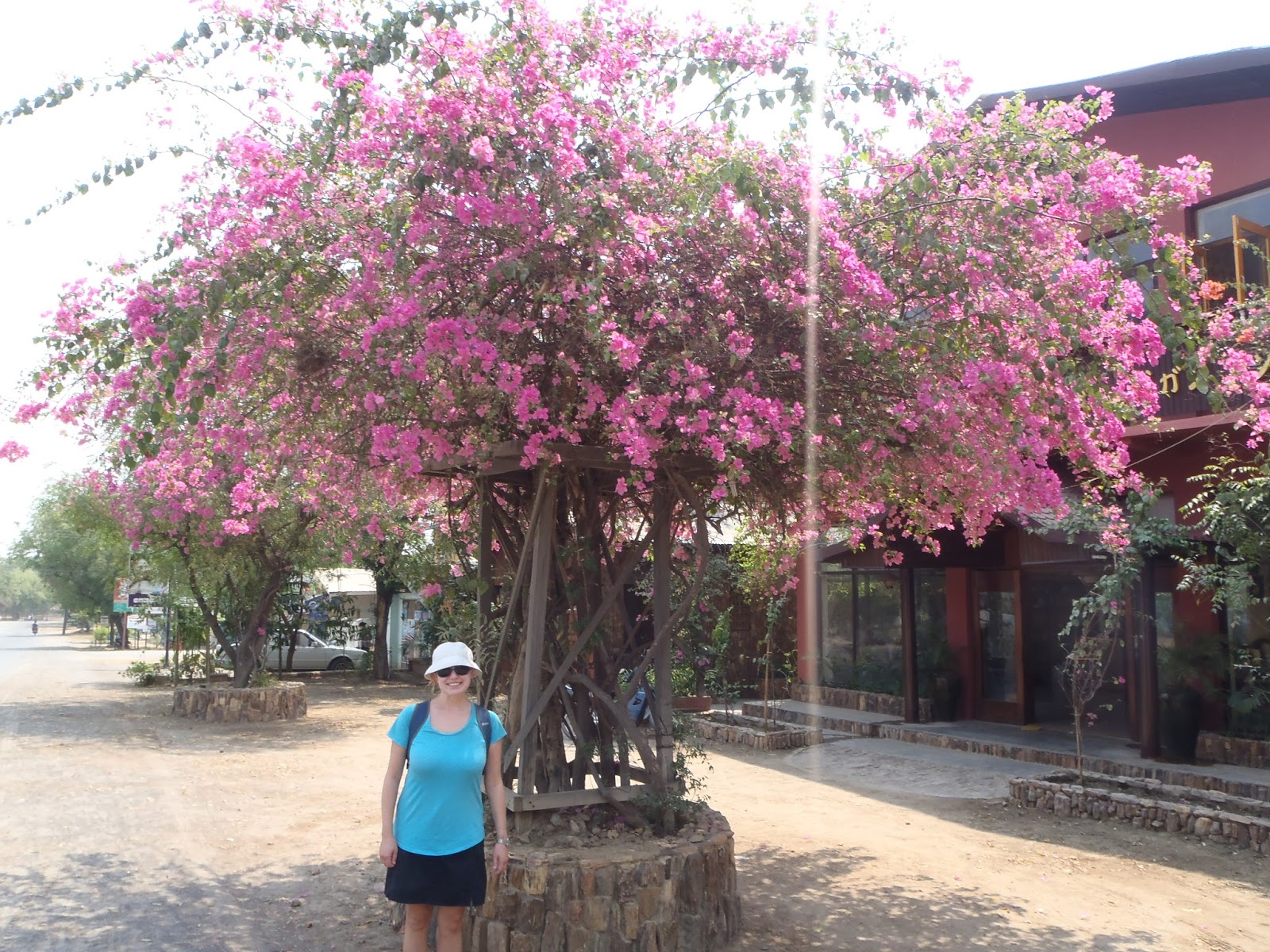
But there's more to do than look at temples.  New Bagan was surprisingly OK to stroll through, in a rural beach-town-with-no-beach kind of way.


Bagan is also known for its handmade lacquerware, so we went to a very organized and tourist-friendly "factory".  Lacquerware is made from strips of bamboo which are tucked together (no fasteners) in the shape of cups, bowls, etc.  The bamboo construtions are then coated and impregnated with lacquer from the "lacquer tree" (not sure what we'd call it) - a type of natural varnish.  This hardens the item and sticks the bamboo strips together.  The lacquer is cured in a cool basement for a week between each coat and sanding - many coats are applied, for durability.  Then different colour paints are applied, and designs and scenes are created by hand etching.  Traditionally the paints are red, yellow and green, from natural pigments.  Alternatively the surface might be painted with a brush, but it's all done freehand.  In the end you have a beautiful, durable, waterproof, heat-resistant and very light-weight item.


This skilled bamboo maker peeled several strips from an already-thin piece of bamboo, then tucked them into a circular shape to form...


...a bracelet for Sarah!


The curing cellar - all of the red, yellow and green art is the result of etching.  The furniture pieces are particularly time consuming - a big chest of drawers could take 1 year to make.


All this temple viewing and lacquerware learning can make one thirsty - so how about a glass of refreshing avocado juice?  It's lightly sweetened really is genuinely tasty.

OK, we can see why people travel to Bagan.  You should probably go too.